
![[UEH 50 Years] A Multidisciplinary and Sustainable University: A strategic transformation to expand the frontiers of knowledge and create value for the community](/images/upload/img_background/ueh-background-639286299966137467.png)
[UEH 50 Years] A Multidisciplinary and Sustainable University: A strategic transformation to expand the frontiers of knowledge and create value for the community
26 Oct 2026

The 2021-2026 period marked a significant transformation for the University of Economics Ho Chi Minh City (UEH), as its Multidisciplinary and Sustainable University strategy was progressively implemented, building on decades of accumulated academic strengths. Expanding beyond its traditional strengths in economics, business, and management into technology, design, data, and emerging fields, UEH developed interdisciplinary education and research capabilities to address complex societal challenges. At the same time, sustainable development became a shared goal, connecting different areas of expertise and guiding university-wide activities, laying the foundation for a journey of co-creating value and making meaningful contributions to the country's development.
Read More![[UEH 50] Launching Ceremony UEH Technology Convergence Hub and UEH FLEX Pilot Project: A Convergence Point for Technology, Knowledge Connection, and Innovation for Sustainable Development](/images/upload/img_background/ueh-background-639286062840240087.png)
[UEH 50] Launching Ceremony UEH Technology Convergence Hub and UEH FLEX Pilot Project: A Convergence Point for Technology, Knowledge Connection, and Innovation for Sustainable Development
25 Oct 2026
Amidst the context where science, technology, and innovation are increasingly becoming vital drivers of socio-economic development, the University of Economics Ho Chi Minh City (UEH) continues to materialize its multi-disciplinary and sustainable university development strategy through the establishment of the Technology Convergence Hub (TCH)—a technology convergence point and a strategic core within the UniverCity Innovation Hub ecosystem. Concurrently, right at the TCH space, UEH officially launched UEH FLEX—a pilot collaboration program with the K-City Network to introduce the Demand Responsive Transit (DRT) pilot project.
Read More![[UEH 50] JABES Launches Special Issue Celebrating the 50th Anniversary of UEH: 12 Research Papers Accompanying Vietnam's Development Issues](/images/upload/img_background/ueh-background-639283721313310617.png)
[UEH 50] JABES Launches Special Issue Celebrating the 50th Anniversary of UEH: 12 Research Papers Accompanying Vietnam's Development Issues
23 Oct 2026
On the occasion of the 50th anniversary of the University of Economics Ho Chi Minh City (1976–2026), the Journal of Asian Business and Economic Studies (JABES) has launched a Special Issue featuring 12 research studies focusing on critical issues for Vietnam’s future development: higher education innovation, urban development, the establishment of an international financial center, economic growth promotion, and social welfare enhancement. Continuing UEH's academic development journey, this publication offers scientific perspectives and policy implications, affirming the role of academic knowledge in accompanying the development of Ho Chi Minh City and the nation.
Read More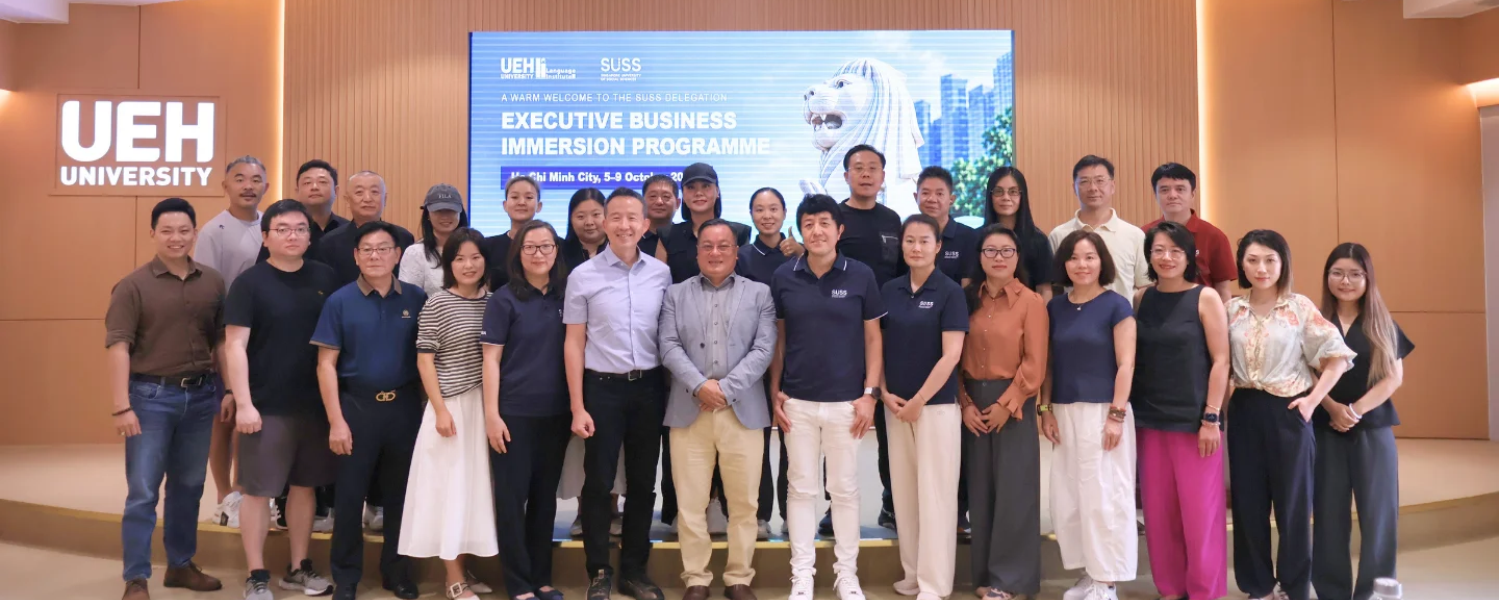
Executive Business Immersion Programme in Vietnam 2026: Exploring Vietnam’s Business Environment and Building Management Connections
21 Oct 2026
From October 5 to 9, 2026, the UEH Institute of Languages and International Studies (UEH-LI) welcomed a delegation of Executive Master of Business Administration (EMBA) students from Singapore University of Social Sciences (SUSS) to participate in the Executive Business Immersion Programme in Vietnam. Combining academic sessions, corporate experiences, and networking activities, the programme provided participants with opportunities to explore Vietnam’s business environment, exchange management experiences, and broaden their perspectives on leadership in the regional context.
Read More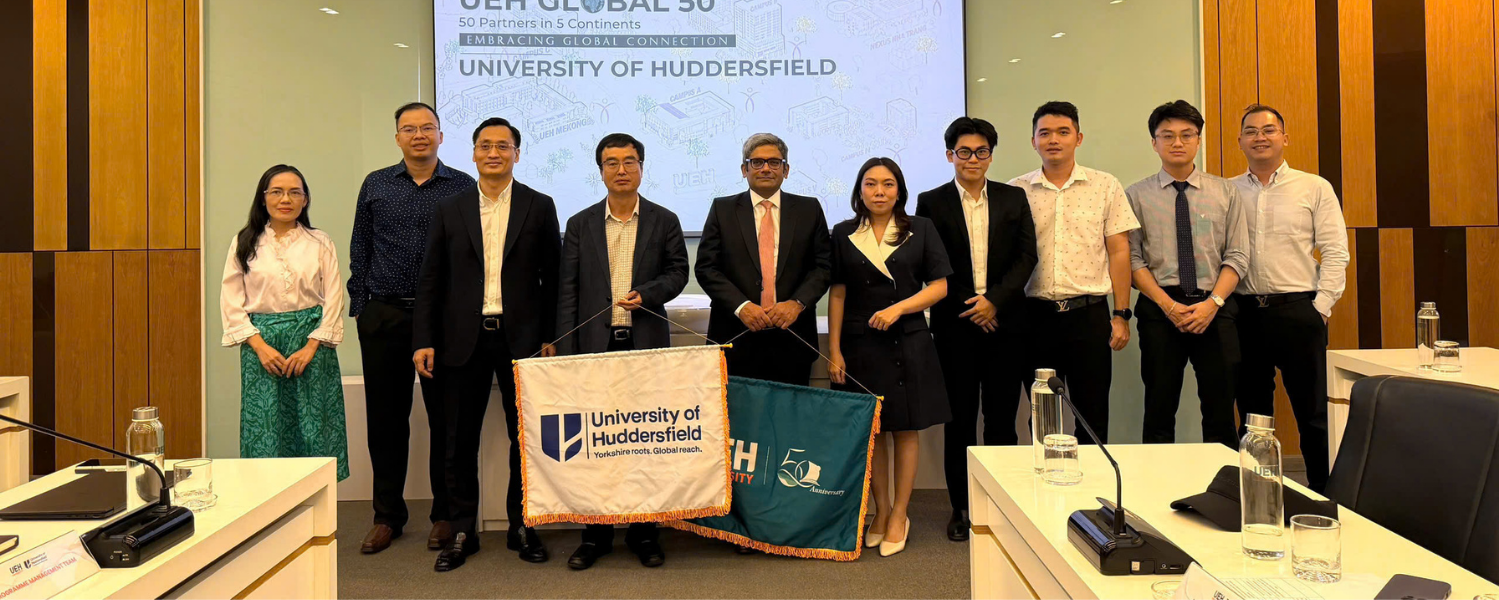
UEH collaborates with the University of Huddersfield to launch the Joint Ph.D. Training Program in Business and Management
21 Oct 2026
On October 16, 2026, the University of Economics Ho Chi Minh City (UEH), in collaboration with the University of Huddersfield (United Kingdom), successfully organized the Opening Ceremony for the Joint Ph.D. Training Program in Business and Management (in the fields of Economics and Management) between the two institutions.
Read More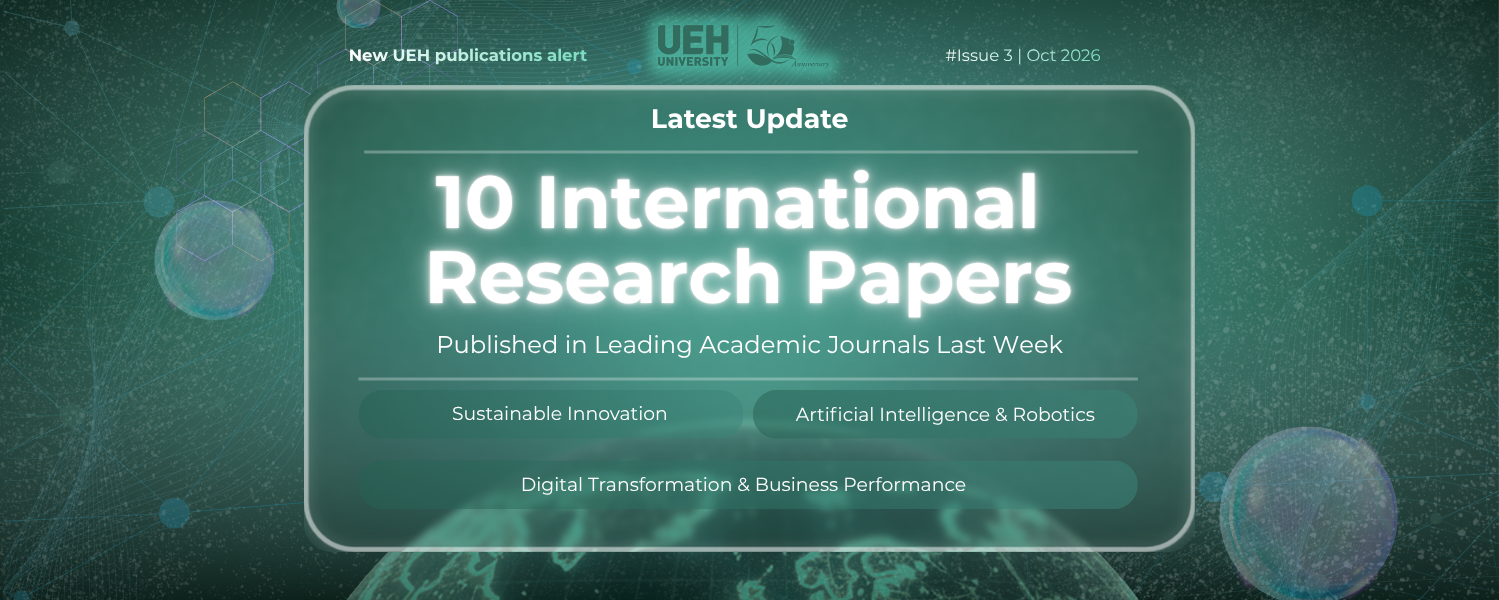
New UEH Publications Alert (Week 3 – October 2026): From Theoretical Frameworks to Robotics Systems and Human-Centered Technology
21 Oct 2026

In Week 3 of October 2026, the University of Economics Ho Chi Minh City (UEH) continued to record numerous new international publications, expanding its research scope from theoretical foundations in governance, innovation, and economic behavior to highly applicable technological solutions. This week’s studies connect robotics, computer vision, and artificial intelligence with digital transformation, sustainable development, and socio-economic challenges, reflecting UEH’s multidisciplinary research orientation that links academic knowledge with practical needs.
Read More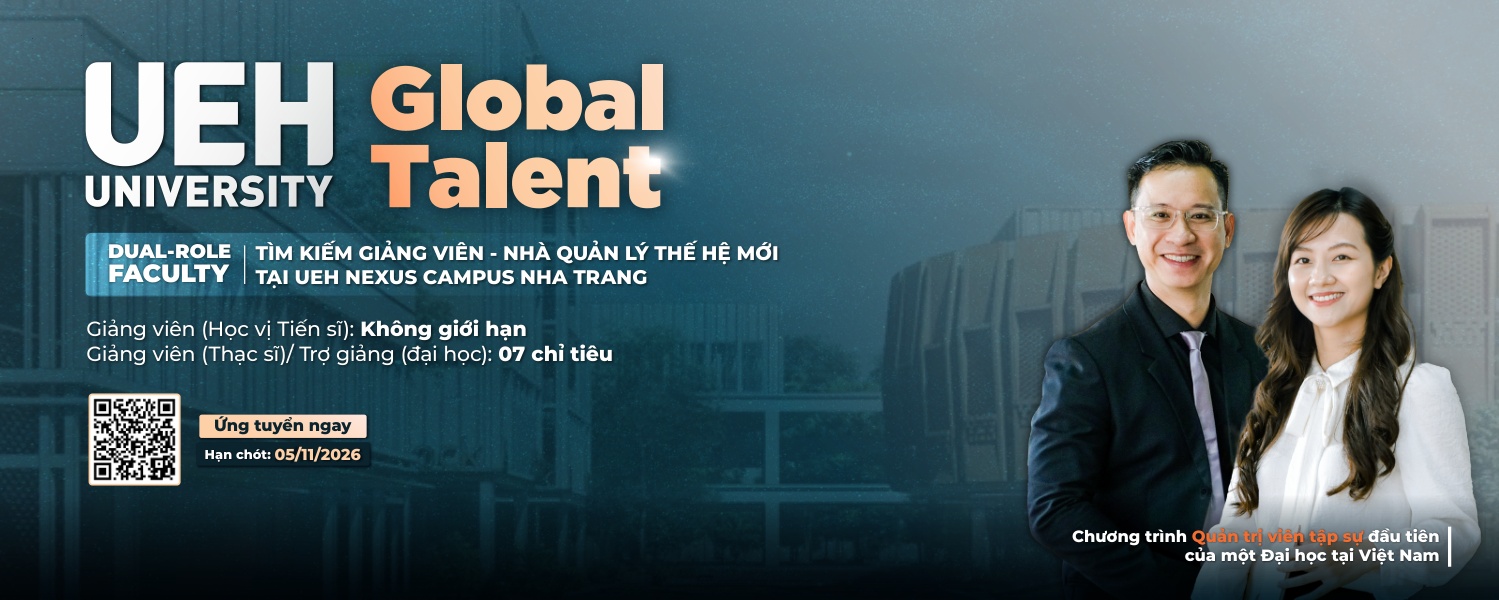
UEH Nexus Campus Nha Trang officially launches phase 3 recruitment: Searching for next-generation faculty & managers
20 Oct 2026
The University of Economics Ho Chi Minh City (UEH) has officially opened the 3rd recruitment phase for 2026 under the Talent Attraction and Development Program for UEH Nexus Campus Nha Trang, aiming to build a team of next-generation Dual Role Faculty (combining teaching and management roles). Featuring a practical training roadmap, study support policies, and a dedicated mentoring team, the program opens up opportunities to simultaneously develop teaching, research, and university governance capacities, joining the pioneering team in building the UEH Branch in Khanh Hoa. Application deadline: November 5, 2026.
Read More![[UEH 50 Years] Internationalization: The Journey of Bringing Global Knowledge to UEH and Elevating Vietnam’s Academic Standing](/images/upload/img_background/ueh-background-639280223905017963.png)
[UEH 50 Years] Internationalization: The Journey of Bringing Global Knowledge to UEH and Elevating Vietnam’s Academic Standing
19 Oct 2026
Over 50 years of establishment and development (1976–2026), the University of Economics Ho Chi Minh City (UEH) has progressively made internationalization a strategic driver for enhancing educational quality, research capacity, and academic standing. From its earliest educational cooperation programs to internationally benchmarked academic programs, a network of 125 global education partners, and achievements recognized by prestigious university rankings, UEH is transitioning from receiving global knowledge to proactively connecting, contributing to, and co-creating international academic value.
Read More![[UEH 50] National Forum on English-Medium Instruction (EMI) 2026: Advancing the Internationalization Strategy of Vietnamese Higher Education](/images/upload/img_background/ueh-background-639280172883934121.png)
[UEH 50] National Forum on English-Medium Instruction (EMI) 2026: Advancing the Internationalization Strategy of Vietnamese Higher Education
19 Oct 2026
As part of the key events leading up to the 50th anniversary of the University of Economics Ho Chi Minh City (UEH50), UEH organized the 2026 National Forum on English-Medium Instruction (EMI) on October 17, 2026. Themed “English-Medium Instruction: A Strategic Driver for Vietnam’s National English as a Second Language Initiative,” the Forum aimed to facilitate discussions on policy directions, international experience, and the conditions necessary for the effective and sustainable implementation of EMI in Vietnamese higher education.
Read More![[UEH 50 Years] A Multidisciplinary and Sustainable University: A strategic transformation to expand the frontiers of knowledge and create value for the community](/images/upload/thumbnail/ueh-thumbnail-639286299966128227.png)
![[UEH 50] Launching Ceremony UEH Technology Convergence Hub and UEH FLEX Pilot Project: A Convergence Point for Technology, Knowledge Connection, and Innovation for Sustainable Development](/images/upload/thumbnail/ueh-thumbnail-639286062840222030.png)
![[UEH 50] JABES Launches Special Issue Celebrating the 50th Anniversary of UEH: 12 Research Papers Accompanying Vietnam's Development Issues](/images/upload/thumbnail/ueh-thumbnail-639283721313299577.png)
![[UEH Through the Lenses of Time #01] UEH 50 Years: From the Classroom Window to the Aspiration to Contribute](/images/upload/thumbnail/ueh-thumbnail-639282664984784994.png)
![[UEH Through the Lenses of Time #02] School of Mathematics - Statistics: Generations of Deans and the Journey of Continuation](/images/upload/thumbnail/ueh-thumbnail-639282663344912443.png)