New UEH Publications Alert (Week 1 – November 2026): Connecting Institutional Quality, Financial Innovation, and Mastery of Indigenous AI Architectures
13 Nov, 2026

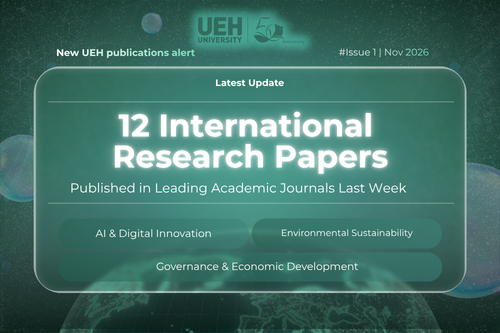
In Week 1 of November 2026, the University of Economics Ho Chi Minh City (UEH) continued to record numerous new international publications, expanding its research scope from institutional quality, inequality, and climate resilience to financial innovation, corporate governance, and the development of indigenous AI technologies. This week’s studies connect economics, finance, accounting, management, data science, and artificial intelligence, shedding light on the mechanisms that determine how resources can be transformed into inclusive growth and practical value.
Institutions, Urbanization, and Inclusiveness in Climate Adaptation
Research on sustainable development places governance quality and distribution structures at the center of analysis, demonstrating that economic growth and structural transformation do not automatically generate positive outcomes without an appropriate institutional foundation.
- - Urbanization and the Informal Economy: Using panel data from 63 Vietnamese provinces and cities for the 2006–2021 period, combined with Fixed Effects and System GMM models, this study analyzes the impact of urbanization on the size of the shadow economy. The findings highlight the role of formal business sector expansion and local governance quality in the process of economic formalization. The study demonstrates that urbanization does not automatically reduce the informal economy without appropriate institutional conditions and a supportive business environment.
- - Income Inequality and Climate Adaptation Readiness: Analyzing 35 Asian economies over the 1996–2023 period, this study identifies two mediating mechanisms linking income inequality to climate change adaptation readiness: increased climate vulnerability and elite capture. The findings emphasize that inequality is not merely an issue of income distribution but can also undermine a country's adaptive capacity, highlighting the need for inclusive climate policies and measures to protect vulnerable groups.
- - Public Expenditure Efficiency in Achieving the Sustainable Development Goals: Based on cross-country data from 2000–2024, this study examines the relationship between government expenditure and progress toward the Sustainable Development Goals (SDGs), while analyzing the conditional roles of financial development and economic development. The study shows that the effectiveness of public expenditure policies must be considered in the context of each country's financial capacity and level of development.
Green Finance, Corporate Governance, and Operational Practices
At the intersection of finance, accounting, and strategic management, this week's studies provide further evidence of the roles played by institutions, leadership characteristics, and innovation capabilities in shaping the performance of economies and businesses.
- - The Finance–Environment Kuznets Curve and Air Pollution: Drawing on data from 36 Asian economies over the 1996–2022 period, this study examines the nonlinear relationship between financial development and air pollution through the Finance–Environment Kuznets Curve (FEKC). The research helps clarify the conditions under which financial development may be associated with either environmental improvements or increased environmental pressures.
- - Environmental Taxes and Institutional Quality: Adding a fiscal policy perspective, this study analyzes the impacts of environmental taxes and CO₂ emissions on economic growth in developing countries, while examining the moderating role of institutional quality. The findings emphasize that the effectiveness of environmental tax instruments depends significantly on each country's governance capacity and institutional conditions.
- - CEO Characteristics and Accounting Information Quality: Focusing on CEOs with military backgrounds, this study analyzes the relationship between military service experience and accrual-based income smoothing behavior. Beyond examining whether this group of CEOs exhibits different income-smoothing tendencies, the research also assesses how such behavior affects the usefulness of current earnings and stock prices in predicting firms' future performance.
- - Innovation and Firm Performance: Against the backdrop of the transition toward a knowledge-based economy, this study on innovation analyzes the challenges businesses face in strategic planning, resource allocation, and sustaining innovation activities. The research emphasizes the role of strategic orientation and systematic support in strengthening innovation capabilities, thereby improving firm performance.
- - Operational Optimization in Manufacturing Enterprises: Addressing practical challenges faced by small and medium-sized enterprises (SMEs) in Vietnam's agro-processing sector, particularly the cashew industry, this study applies Digital Twin technology and predictive maintenance to analyze equipment conditions and their impacts on production operations. The research identifies losses caused by machinery breakdowns and maintenance costs as significant bottlenecks, while opening up opportunities for digital technology applications to enhance operational efficiency.
- - Digital Communication and Food Waste Reduction: Connecting influencer marketing with behavioral psychology and sustainable consumption, this study analyzes how sustainability messages delivered by influencers can encourage food waste reduction behaviors. Factors such as perceived value and eco-guilt are examined as psychological mechanisms that help translate communication messages into responsible consumption actions.
Mastering AI Technologies: From Algorithmic Fairness to Vietnamese Multimodal Models
This week's computer science publications demonstrate progress beyond the application of existing AI tools toward research into model architectures, improvements in machine learning quality, and solutions to fairness and reliability challenges in intelligent systems.
- - Developing Vistral-V, a Vietnamese Vision-Language Model: A technological highlight is Vistral-V, a multimodal AI architecture designed and optimized for Vietnamese. The research combines the Mistral-7B language model with the SigLIP image encoder through a lightweight and scalable integration mechanism. This approach contributes to the development of capabilities for jointly processing Vietnamese language and images, opening up potential applications in education and digital services in Vietnam.
- - Semantic Noise Reduction in Multimodal Machine Learning: This study on Video Captioning addresses the phenomenon in which repetitive audio patterns create spurious correlations between video and language representations. Through the Partial Distance Correlation method, the research aims to reduce the influence of confounding factors, enabling models to focus more effectively on the genuine semantic relationships between visual content and linguistic descriptions.
- - Nonlinear Fairness in Recommender Systems: This study proposes an approach combining contrastive learning with energy statistics to mitigate bias in recommender systems. The research highlights the limitations of traditional fairness metrics such as demographic parity and Pearson correlation, which primarily capture linear relationships and may overlook nonlinear forms of discrimination related to gender and age. This represents an important approach toward developing more responsible, transparent, and trustworthy AI systems.
From Institutional Quality to Technological Sovereignty: Creating Interdisciplinary Value
The publications in Week 1 – November 2026 demonstrate the integration of modern econometric methods, including dynamic panel System GMM models, nonlinear regression, and mediation and moderation analysis, with the capability to design deep learning architectures. This convergence enables research to address interconnected issues in institutions, finance, corporate governance, sustainable development, and technology.
In particular, research on the Vietnamese multimodal model Vistral-V, together with studies on algorithmic fairness and semantic noise reduction, demonstrates efforts to achieve deeper mastery of AI technology platforms. Through these contributions, UEH continues to affirm its multidisciplinary research orientation, generating international knowledge while addressing strategic challenges related to institutional quality, inclusive growth, financial innovation, and Vietnam's technological capabilities, as well as those of the wider Asian region.
List of Publications This Week
- Does urbanization formalize the economy? The role of local governance in Vietnam
Authors: Cong Minh Huynh, Nam Hoai Tran (UEH)
Journal: Cities, WOS (SSCI Q1) - From Smog to Sustainability: Financial Development and the Turning Point of the Environmental Kuznets Curve
Authors: Cong Minh Huynh, Nam Hoai Tran
Journal: Global Economic Review, WOS (SSCI Q1) - From climate vulnerability to elite capture: the hidden pathways linking inequality to climate adaptation readiness
Authors: Cong Minh Huynh, Nam Hoai Tran
Journal: Ecological Economics, WOS (SSCI Q1) - Ex-military CEOs and income smoothing
Authors: Long Thai Bui, Huy Viet Hoang, Anh Tuan Nguyen
Journal: Accounting Research Journal, Scopus Q1 - Environmental taxes, CO2 emissions, and economic growth: evidence on the moderating role of institutional quality in developing countries
Authors: Van Cuong Dang, Le Hong Ngoc, Thi Thanh Tam Nguyen
Journal: Journal of Applied Accounting Research, Scopus Q1 - Influencer Sustainability Messaging for Food Waste Reduction: The Roles of Perceived Value and Eco-Guilt in Sustainable Consumption
Authors: Tien Dat Huynh, Gia Han Ly, Trung Nhan Dao, Ngoc-Trung Nguyen, Ngoc-Hong Duong
Journal: International Journal of Sustainable Development and Planning, Scopus Q2 - Partial Distance Correlation for Confounding-Aware Video Captioning
Authors: Trung Thanh Le, Thang Cong Pham, Hiep Xuan Huynh
Publication type: Book chapter - Energy-Based Fair Recommendations: Unifying Contrastive Learning and Energy Statistics for Bias Mitigation
Authors: Gam Thi Hong Le, Khoi Nguyen-Tan, Hiep Xuan Huynh
Publication type: Book chapter - Riding the Innovation Wave: Global Insights Into Firm Performance
Authors: Xuan Thang Nguyen, Huy Viet Hoang, Cong Thanh Nguyen, Thanh Tat Tran, Son Hoai Nguyen
Journal: Sage Open, WOS (SSCI Q1) - Towards sustainable development goals (SDGs): Exploring the synergies of government expenditure, financial and economic development
Authors: Kim Quyen Nguyen, Thanh Huu Phu Nguyen, Dang Thi Bach Van, Hoang Phong Le
Journal: Journal of Open Innovation: Technology, Market, and Complexity, Scopus Q1 - Digital Twin–Driven Predictive Maintenance in Resource-Constrained Manufacturing: Comparative Models and Operational Impact from a Vietnam Case
Authors: Quoc Hung Nguyen, Thuc Anh Luong, Pham Bao Han Vu, Hoang Tan Luong, Phuong Tram Vo, Nguyen Minh Thu Pham
Publication type: Book chapter - Vistral-V: A Lightweight and Vietnamese-Optimized Multimodal Language Model with SigLIP Vision Encoder
Authors: Quoc Hung Nguyen, Le Thanh Oanh Nguyen, Pham Bao Khanh Truong, Thanh Thao Mai, Ngoc Quynh Thu Luong, Viet Bao Tran Nguyen
Publication type: Book chapter
Explore the List of Publications for Week 1 – November 2026 at:
https://news.ueh.edu.vn/2026/scientist/W1Nov.html
Explore the complete New UEH Publications Alert for 2026 at:
https://news.ueh.edu.vn/en/scientist
The New UEH Publications Alert series will continue to provide weekly updates on UEH's latest international publications. Faculty members, staff, alumni, and learners are cordially invited to follow the series and join UEH in spreading the spirit of “Research Contribution for All”.
Pillar: Research
News, photos: Department of Research - Development and Global Engagement; Department of Communications and Partnerships