New UEH Publications Alert (Week 4 – October 2026): Building Interdisciplinary Knowledge, Decoding the Mechanisms of Economic and Social Transformation
03 Nov, 2026


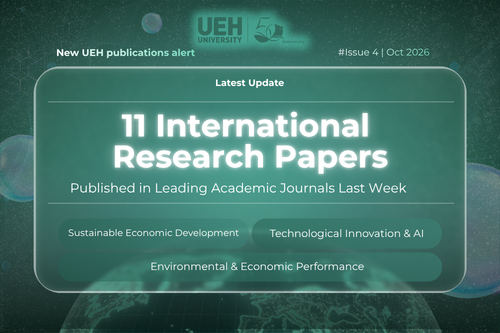
In Week 4 of October 2026, the University of Economics Ho Chi Minh City (UEH) recorded a new set of international publications. Their research spans sustainable agricultural transition, fiscal policy uncertainty, corporate competitiveness and organizational behavior. This week’s studies connect economics, management, technology, the environment, education and forensic science, shedding light on the institutional, technological and psychological mechanisms that shape socio-economic transformation.
1. Sustainable Agriculture and the Awareness–Behavior Gap
Amid mounting environmental pressures and growing demand for sustainable production, a study on farmers’ choices to convert to organic rice farming in the Mekong Delta addresses a notable paradox: although organic agriculture is attracting increasing attention, the share of farmers who actually switch from conventional farming practices remains limited.
Using a Discrete Choice Experiment, the study analyzes farmers’ preferences and the factors influencing their decisions to adopt organic farming. The findings suggest that the green transition in agriculture depends not only on technology or production conditions, but also on farmers’ choices, motivations and the barriers embedded in their economic behavior.
2. Public Finance and a New Measure of Policy Uncertainty
Research capacity in financial econometrics is reflected in a study that constructs a Fiscal Policy Uncertainty (FPU) measure for the United States. Applying the COVOL framework of Engle and Campos-Martins (2023), the study develops overall, short-term and long-term uncertainty indices at a daily frequency, based on the common volatility of assets sensitive to fiscal risk from September 2013 to April 2025. This approach extends the measurement of policy uncertainty beyond traditional statistical indicators to signals reflected directly in financial markets, providing an additional quantitative tool for macroeconomic risk analysis and management.
3. Competitiveness and Organizational Behavior in the Digital Era
Studies on corporate management continue to clarify how organizations turn resources into competitive advantage, while analyzing the leadership and psychological factors that shape workforce behavior in a changing context.
- Strategic management and competitiveness: Analyzing data from 638 listed companies in Vietnam, the study integrates the Resource-Based View (RBV), Dynamic Capabilities Theory (DCT) and Signaling Theory. Building on a resources–capabilities–performance framework, it clarifies how firms convert internal resources into organizational capabilities and competitive outcomes in an emerging economy.
- Narcissistic leadership and counterproductive behavior among Gen Z employees: The study focuses on the relationship between narcissistic leadership and counterproductive work behavior among Generation Z employees in Vietnam. Through a moderated serial mediation model, it examines the roles of organizational cynicism, turnover intention and moral disengagement, offering insight into the psychological and organizational mechanisms that shape employee behavior.
4. Sustainable Communication and the Economics of Everyday Life
Insight into consumer behavior and applied economic issues continues to deepen through studies on digital communication, health policy and the real estate market.
- Green influencers and the authenticity of environmental messages: Set in the context of TikTok, the study analyzes how followers of environmental content creators form and express skepticism about the authenticity of green messages and the risk of greenwashing through electronic word-of-mouth (e-WOM). The findings show that users do not simply receive information, but actively negotiate, evaluate and challenge environmental messages on digital platforms.
- Co-payment policy and public health: Conducted in rural Vietnam, the study examines the relationship between co-payment exemption for medical costs and self-reported health. It adds empirical evidence on how health cost-sharing policies affect health outcomes, an area in which research from developing countries remains limited.
- Housing prices and market liquidity: Examining cases in which properties are listed below their hedonic reference price yet still struggle to sell, the study analyzes the relationship between price and liquidity. In doing so, it raises questions about non-price burdens and hidden factors that listed prices alone do not fully capture.
5. Artificial Intelligence, Education and Forensic Science
This week’s studies further broaden the application of technology and interdisciplinary knowledge, from supporting teaching to developing methods for forensic investigation.
- Forensic science and 3D facial reconstruction: The study applies deep learning to develop a 3D Forensic Facial Reconstruction (FFR) method, using a skull-conditioned U-Net model to infer facial morphology. FFR supports investigations in cases where primary identifiers such as DNA, dental records or fingerprints are unavailable or inconclusive. The method aims to generate anatomically plausible facial images that aid recognition and narrow the search for individuals, rather than establishing identity directly.
- GenAI in English language teaching: Drawing on the Technological Pedagogical Content Knowledge (TPACK) framework, the study uses a qualitatively driven mixed-methods design to explore teachers’ perspectives on the benefits, challenges and strategies of using generative AI in English language teaching. It highlights the importance of teachers’ pedagogical competence and technological mastery in integrating GenAI into effective teaching and learning activities.
6. Environmental Economics and Methodological Diversity
Environmental studies continue to broaden approaches to the relationship between technological progress, financial development and environmental quality, rather than assuming these factors always have positive effects.
- Technological innovation, internet penetration and environmental quality in ASEAN-5: The study analyzes the effects of technological progress, internet penetration, financial development and economic growth on CO₂ emissions in five ASEAN countries from 2000 to 2020. The findings help clarify the links between technological transformation, economic development and environmental quality goals in the region.
- Renewable energy, bank credit and industrial robots: Extending the analysis to the top five countries for industrial robot installations – China, Japan, the United States, Germany and South Korea – the study assesses the asymmetric effects of renewable energy use, domestic bank credit and industrial robots on environmental sustainability. Using two measures, ecological footprint and greenhouse gas emissions, it offers a multidimensional view of the relationship between automation, finance and the environment.
The convergence of high-frequency financial data, firm-level panel data, mediation–moderation models, choice experiments, mixed-methods designs and environmental econometrics reflects the methodological diversity of this week’s publications. From farmer behavior and corporate strategy to public policy, educational technology and global environmental issues, the studies share a common aim of unpacking the complex mechanisms that drive socio-economic transformation. In doing so, UEH continues to affirm its multidisciplinary research orientation, connecting academic foundations with real-world issues while fostering innovation, enhancing social welfare and advancing sustainable development.
Publications of the Week
- Farmers’ preferences for adopting organic rice farming in Vietnam’s Mekong River Delta: insights from discrete choice experiments
Authors: Huu Phuong Chi Ho, Tuan Kiet Nguyen, Cong Duc Trinh
Journal: Environment, Development and Sustainability, WOS (SCIE Q2) - Measuring U.S. fiscal policy uncertainty: The COVOL approach
Authors: Tam Hoang Nhat Dang, Canh Phuc Nguyen, David Gabauer
Journal: Quality and Quantity, Scopus Q1 - Follower Skepticism Toward Green Influencers: E-WOM Insights on Authenticity and Greenwashing
Authors: Thi-Thao Nguyen, Thai-Thinh Dang
Journal: International Journal of Consumer Studies, WOS (SSCI Q1) - Empirical analysis of enterprise competitiveness in Vietnam: Key determinants and their interactions
Authors: Wann-Yih Wu, Wei-Shiun Chang, Ying-Kai Liao, Gia Vung Dang, Quang Huan Ngo, Duong Son Tran, Nu To Giang Truong, Dam Huy Trung Thai
Journal: Asia Pacific Management Review, Scopus Q1 - Narcissistic leadership and counterproductive work behavior among Gen Z employees in Vietnam: a moderated serial mediation model
Authors: Binh Anh Doan, Ngoc Bao Mai Pham
Journal: Evidence-based HRM, Scopus Q2 - Co-payment exemption and self-reported health: Evidence from rural Vietnam
Authors: Anh Tuan Truong, Khanh Nam Pham, Thanh Loan Le
Journal: SN Business and Economics, Scopus Q3 - When Discounts Fail to Clear: Price–Liquidity Divergence and Selective Shadow Costs in an Opaque Housing Market
Authors: Hiep Thanh Truong, Hong Thi Bich Nguyen
Journal: Journal of Real Estate Literature, Scopus Q2 - Deep learning-based 3D forensic facial reconstruction: a volumetric morphological inference approach using a skull-conditioned U-Net
Authors: Nguyen Tuan Kiet, Nguyen Truong Thinh
Journal: International Journal of Legal Medicine, WOS (SCIE Q1) - Teachers’ perspectives about the benefits, challenges, and strategies for using generative AI in English language teaching
Authors: Tran, Tran Le Nghi, Le, Thinh Van, Nguyen, Thanh Luan
Journal: JALT CALL Journal, Scopus Q1 - Promoting environmental quality in ASEAN-5: the influence of technological innovation, internet penetration, and financial development
Authors: Thanh Phuc Nguyen, Trang Thi-Thuy Duong
Journal: Quality and Quantity, Scopus Q1 - The impact of renewable energy, banking credit, and industrial robots on environmental sustainability in the top five robot installing countries
Authors: Thanh Phuc Nguyen, Trang Thi-Thuy Duong, Thi Nha Truc Phan
Journal: Discover Sustainability, Scopus Q2
View the Week 4 - October 2026 publication list at:
https://news.ueh.edu.vn/2026/scientist/W4Oct.html
View the full 2026 New UEH Publications Alert at:
https://news.ueh.edu.vn/en/scientist
The New UEH Publications Alert series will continue to bring weekly updates on UEH’s latest international publications. We warmly invite faculty members, alumni and learners to follow the series and help spread the spirit of “Research Contribution for All”.
Pillar: Research
News, photos: Department of Research - Development and Global Engagement, Department of Communications and Partnerships