Organizational Development – Human Resources: Policies that contribute talent in line with the sustainable development goals
11 Feb, 2026

In 2025, Ho Chi Minh City University of Economics (UEH) reached new milestones in human‑resource management, shifting powerfully from a purely operational function to a strategic pillar, guided by a people‑centric philosophy that fuels development.
HR management based on competencies and digital transformation
During 2025 UEH actively rolled out a competency‑based HR model integrated with a comprehensive digital‑transformation agenda. The core of the system is the restructuring and upgrading of the Organizational Development – Human Resources unit into a Strategic HR Business Partner (HRBP) role. This new function directly supports workforce planning, organizational restructuring, and talent development across functional units, member schools, and faculties/research institutes.
Key initiatives include:
Diversifying the recruitment network and introducing targeted incentive packages to attract international scholars and outstanding graduates from world‑renowned universities. At the same time, the onboarding process is being standardized to maximise the contribution of staff with an international academic background.
Applying digital transformation in HR administration to improve management efficiency while guaranteeing objectivity, transparency and fairness in access to employment opportunities.
Linking training with continuous development, enabling each staff member to fully leverage strengths and enhance adaptability in a rapidly changing environment.
Building sustainable capabilities and personalising career paths
UEH has implemented a lifelong‑learning system that tightly links training, upskilling, and career development. Specifically, in 2025 UEH organized 21 internal training programmes and sent staff and employees to a wide range of training topics both domestically and abroad, achieving a total of 1,037 participations—equivalent to 1.1 courses per employee per year.
.png)
The training curriculum focused on:
Applying artificial‑intelligence (AI) tools in daily work;
Sustainability training in partnership with the Association of Chartered Certified Accountants (ACCA);
Collaboration with EMI Oxford to standardise English‑Medium Instruction (EMI) teaching competence.
UEH partnered with the Association of Chartered Certified Accountants (ACCA) to hold a training workshop on Sustainable Development for its leaders, managers, and lecturers (May 2025).
Gender equality, empowerment, and reducing inequities in the workplace and research
In 2025 UEH recorded an increase in the participation of female staff in management, leadership, and specialist council positions, thereby helping to narrow the gender gap and promote balance in university governance.
At the same time, the university organized the international capacity‑building programme “From Idea to Impact: Empowering Female Researchers for Grant‑Writing Success,” in collaboration with the Environment for Development (EfD) network and the WinEED initiative, featuring international female experts. The programme aimed to strengthen research skills, grant‑proposal writing, and international publication outcomes for female lecturers and researchers.
.png)
UEH, together with the Environment for Development (EfD) network and the WinEED programme, organized an advanced training course for female faculty on research and international publication titled “From Idea to Impact: Empowering Female Researchers for Grant‑Writing Success” (July–August 2025).
Built on the ONE UEH cultural foundation, the university’s policies are applied consistently across recruitment, performance appraisal, training, appointment, and remuneration, ensuring that every individual has the opportunity to develop based on competence and contribution.
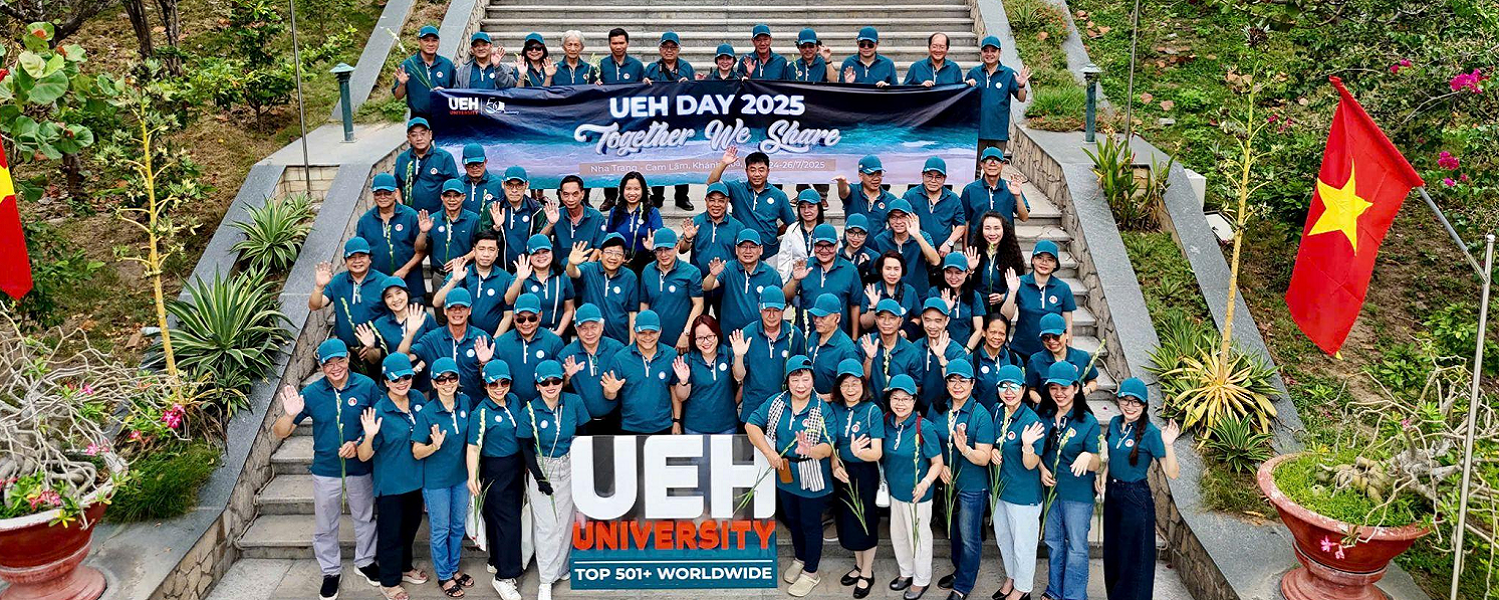
In particular, UEH Day 2025, dedicated to staff and employees, created a space where each person - regardless of gender or position - feels an inseparable part of UEH.
.png)
UEH Day 2025 – Together, We Share – with the participation of nearly 900 UEH staff members and employees.
Besides capacity‑building programmes, UEH remains steadfast in its commitment to non‑discrimination, creating a safe work‑ and research‑environment that respects differences and tolerates no form of violence or harassment.
Developing an internationally competitive academic workforce while promoting welfare, happiness, and sustainable human‑resource practices
Recognising that human capital is the cornerstone for enhancing academic competitiveness and international integration, UEH officially launched the project “Elevating UEH’s Human‑Capital Quality – Top 250 Asia, 2025‑2030.” In 2025 the university recorded notable achievements in standardising and internationalising its staff:
≈ 70 % of full‑time faculty hold Ph.D. degrees.
27.5 % of Ph.D.-qualified faculty have attained the rank of Professor or Associate Professor.
64.35 % of staff in managerial positions possess postgraduate qualifications.
4.6 % of faculty are international visiting scholars.
24 young, high‑potential lecturers and researchers have been recruited.
Understanding that sustainable academic development must go hand‑in‑hand with employee welfare and well‑being, UEH also launched the UEH Well‑being Initiative. This programme aims to improve the quality of the working environment, modernise infrastructure, and promote a healthy work‑life balance for all members of the university community.
.png)
UEH issued retirement decisions for staff and workers, and the unit’s union presented gifts to the retirees of 2025.
Reflecting on the pivotal year 2025, UEH’s shifts in human‑resource policy not only improved managerial efficiency but also served as a clear testament to its commitment to social responsibility, professional ethics, and the Sustainable Development Goals (SDGs). Entering 2026, built on the ONE UEH cultural foundation, the “University of Happiness” spirit, and a people‑centric development orientation, UEH continues to firmly pursue its strategy to elevate its workforce, advance internationalisation, and pursue the Top 250 Asia goal, gradually solidifying its standing as a multi‑disciplinary, sustainable, and responsible university on the global higher‑education map.
New, photos: HOD
![[UEH CONFERENCE 50] UEH Hosts SR-ICYREB 2026, Advancing Student Research and Nurturing the Next Generation of Young Scholars](/images/upload/thumbnail/ueh-thumbnail-639273984608805382.png)