
UEH Shares “From a Sustainable University Strategy to Becoming a Top 101+ University Contributing to All 17 SDGs” at the Times Higher Education University Rankings Workshop
20 Jul, 2026

On 17 July 2026, following its achievement as Vietnam's leading university in the Times Higher Education (THE) Sustainability Impact Ratings 2026, along with strong performance in the THE World University Rankings (THE WUR) and THE Asia University Rankings, the University of Economics Ho Chi Minh City (UEH) was invited by Times Higher Education (THE) to present at a specialized workshop on university rankings - a professional forum connecting higher education institutions across Southern Vietnam.
Co-organized by THE, the workshop focused on updates to the methodologies of the THE World University Rankings, THE Asia University Rankings, and the THE Sustainability Impact Ratings, while exploring the role of data, benchmarking, and strategic governance in driving quality enhancement in higher education.
The event also provided a platform for universities in Southern Vietnam to exchange experiences, identify development gaps, and approach university rankings as a strategic management tool to improve educational quality in line with international standards while increasing societal impact.
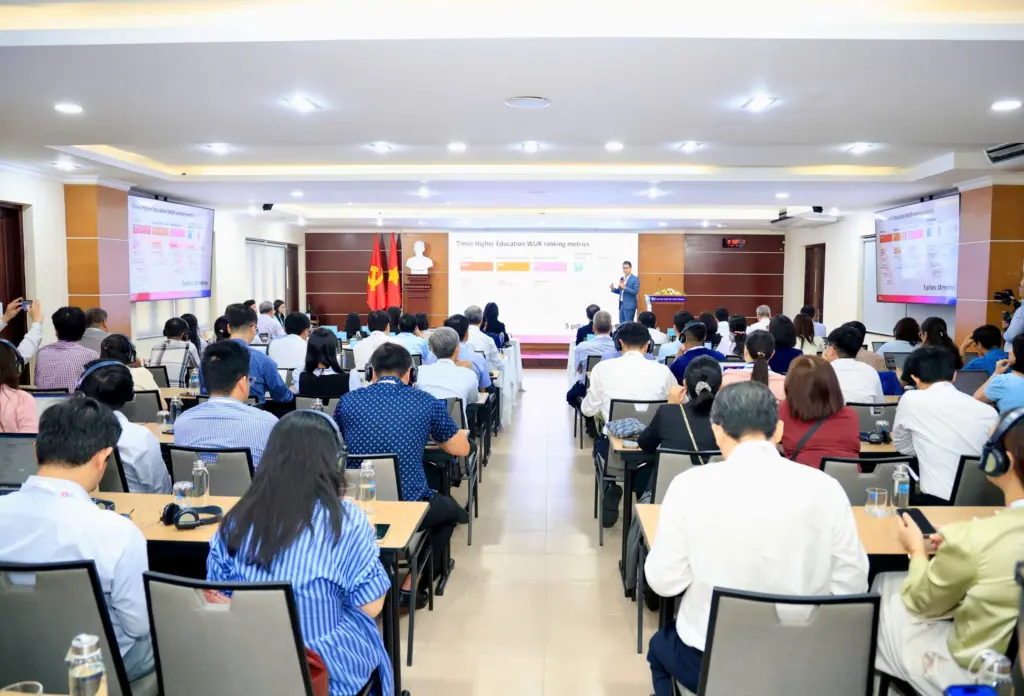
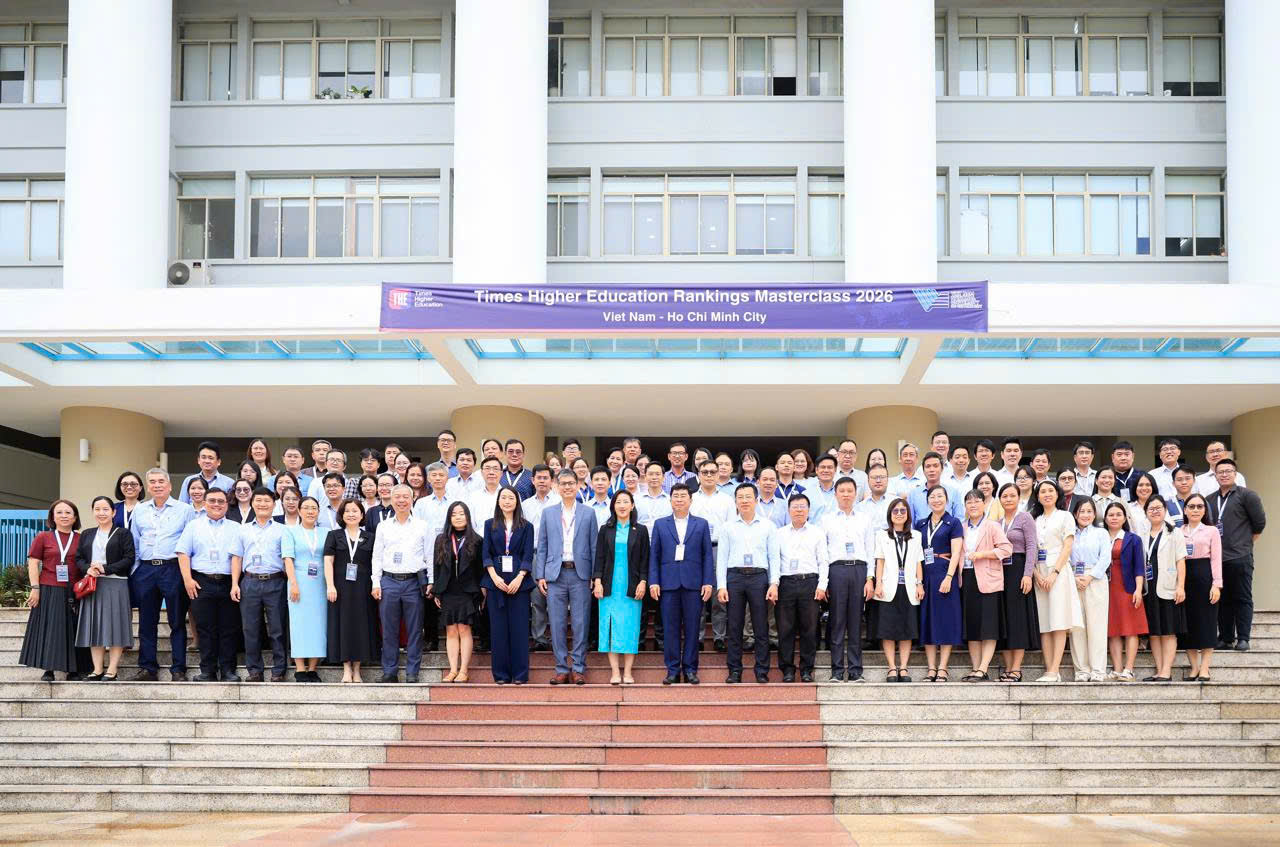
Overview of the specialized workshop co-organized by Times Higher Education (THE) and Vietnam National University Ho Chi Minh City
Representing UEH at the event were Mr. Vo Duc Hoang Vu, Deputy Head of the Department of Research, Development and Global Engagement and Head of the UEH Rankings Task Force; Dr. Le Thi Hanh An, Deputy Head of the Department of Communications and Partnerships and Deputy Head of the UEH Rankings Task Force; together with members of the UEH Rankings Task Force.
On behalf of UEH, Dr. Le Thi Hanh An presented UEH's comprehensive approach to rankings governance, highlighting the University's five-year journey in implementing its Multidisciplinary and Sustainable University Strategy and emphasizing the key factors that contributed to UEH's achievement of being ranked among the Top 101+ universities worldwide contributing to all 17 Sustainable Development Goals (THE Impact Rankings 2026).

Dr. Le Thi Hanh An presents the paper "From a Sustainable University Strategy to Becoming a Top 101+ University Contributing to All 17 SDGs." (Photo credit: Vietnam National University Ho Chi Minh City)
University Rankings Are the Natural Outcome of a Long-Term International Governance Strategy
During her presentation, Dr. Hanh An explained that UEH has adopted an approach that uses international ranking criteria as a framework for comprehensively upgrading all university activities in accordance with global standards. To support this approach, UEH has systematized its rankings governance through a six-step process:
Step 1: Identify four priority rankings: QS Asia University Rankings, THE Asia University Rankings, QS Sustainability Rankings, and THE Impact Rankings - which comprehensively reflect academic excellence, governance quality, and social responsibility while aligning with UEH's multidisciplinary and sustainable development strategy.
Step 2: Benchmark the criteria of these four rankings against Vietnam's national higher education quality standards (Circular No. 01/2024 issued by the Ministry of Education and Training).
Step 3: Develop an integrated framework comprising five strategic standards and 26 specific criteria.
Step 4: Conduct a university-wide assessment based on this integrated framework.
Step 5: Establish measurable targets for each criterion and integrate them directly into the University's Objectives and Key Results (OKRs) system.
Step 6: Apply ranking data management technologies with designated coordinators to monitor progress, evaluate performance against targets, and recommend annual improvement strategies.
These long-term objectives are translated into annual action plans and implemented through the University-wide OKR system involving nearly 1,000 faculty and staff members. As a result, the strategy is no longer solely the responsibility of leadership or a specialized unit, but a shared institutional commitment that reflects the spirit of ONE UEH - one vision, one direction, and one collective effort toward shared achievements.
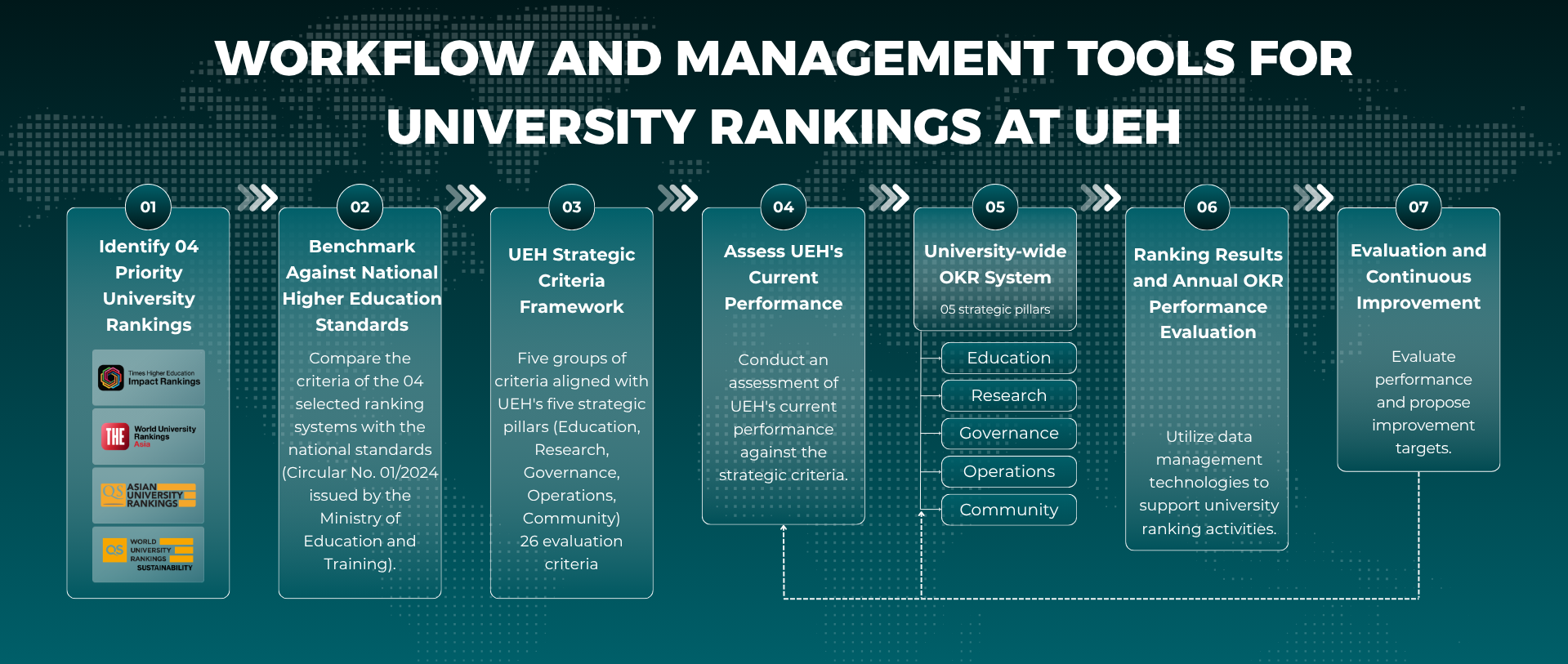
UEH's university rankings governance process and management tools
UEH's philosophy of treating rankings management as a process of continuous institutional improvement has enabled the University to improve its performance across major global rankings, including QS, QS Sustainability, THE, and the THE Impact Rankings. This is because the criteria of these rankings have been systematically integrated into all five of UEH's strategic dimensions: Education, Research, Operations, Community Engagement, and Governance.
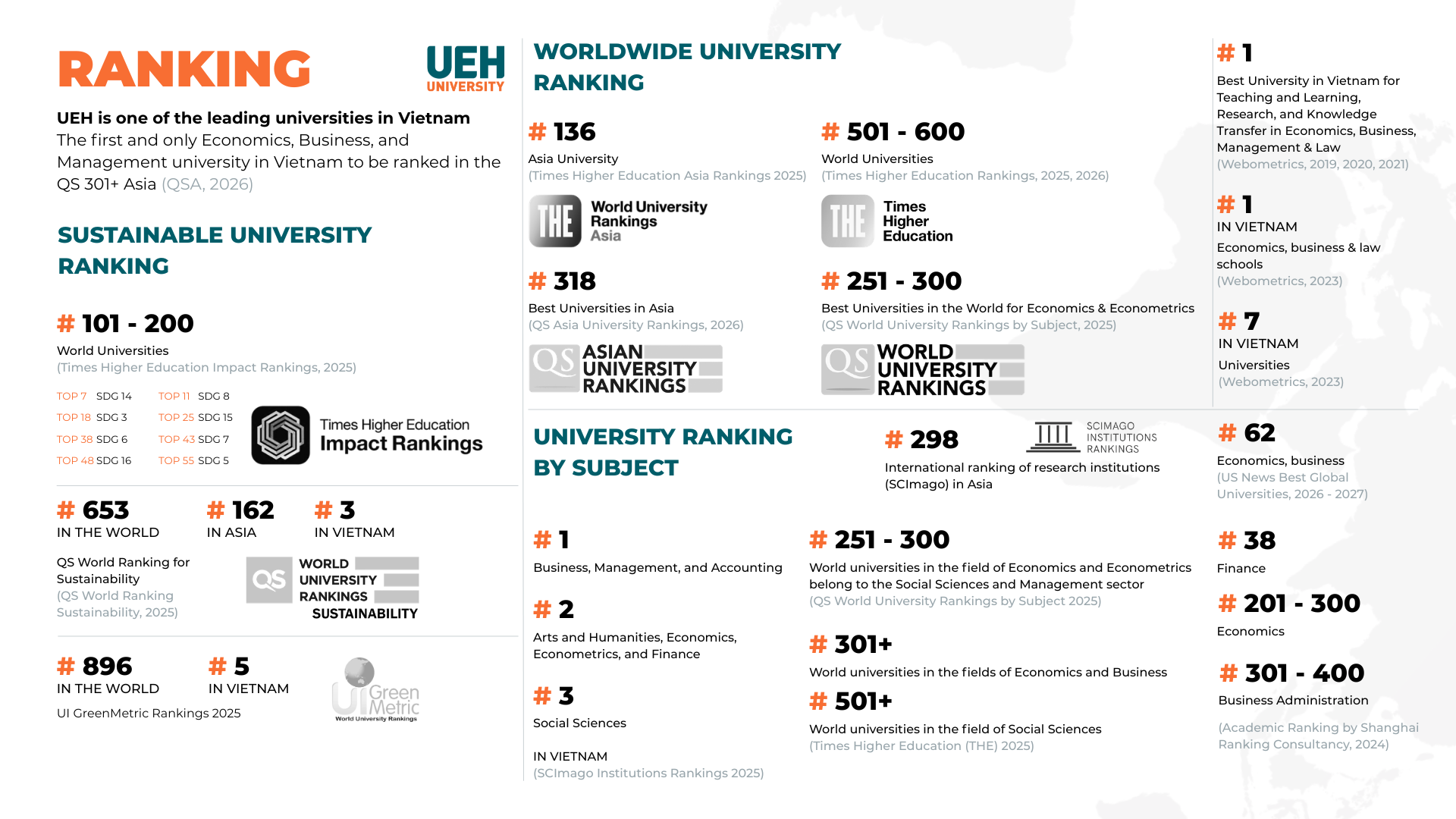
UEH leads numerous international university rankings, including subject-specific rankings
Applying AI Tools and Smart Dashboards for Evidence Management and Progress Monitoring
Alongside its comprehensive governance framework, UEH has adopted AI-powered tools and Smart Dashboards to support the collection, classification, monitoring, and visualization of ranking evidence by criterion and Sustainable Development Goal (SDG).
The application of these technologies helps reduce fragmented data, improve the completeness and consistency of evidence, and enable the University to transition from collecting data solely for reporting purposes to managing data as a strategic asset for monitoring performance, identifying gaps, and continuously improving institutional strategies.
As a result, university rankings have become an integral component of UEH's quality management system rather than simply an annual reporting exercise.
UEH's Multidisciplinary and Sustainable University Strategy: A Long-Term Institutional Transformation, with the Top 101+ THE Impact Ranking Reflecting Progress at Each Stage
Speaking about UEH's Multidisciplinary and Sustainable University Strategy, Dr. Hanh An noted: "UEH began laying the foundations for sustainable development as early as 2011. Ten years later, in 2021, the University officially launched its comprehensive transformation toward a Multidisciplinary and Sustainable University Strategy. It was not until 2023 that UEH first participated in the THE Impact Rankings. For UEH, rankings serve as an international benchmark that allows us to reflect on and evaluate the path we are taking."
After five years of consistent, university-wide implementation across colleges, campuses, faculties, institutes, and administrative units, combined with continuous improvement, UEH achieved compelling results that secured its position among the Top 101–200 universities worldwide out of 1,603 institutions in the THE Sustainability Impact Ratings 2026, climbing 200 places compared to 2025 while becoming Vietnam's highest-ranked university.
A Genuine Strategy Begins with the Smallest Actions
UEH's Multidisciplinary and Sustainable University Strategy has been systematically designed by integrating sustainability and the 17 Sustainable Development Goals (SDGs) into five strategic pillars: Education, Research, Governance, Operations, and Community. This includes empowering learners through Glo-cal education, promoting research that addresses real-world challenges, developing the UEH Green Campus as a Living Lab, and fostering a university community united by a shared vision of leading sustainable action.
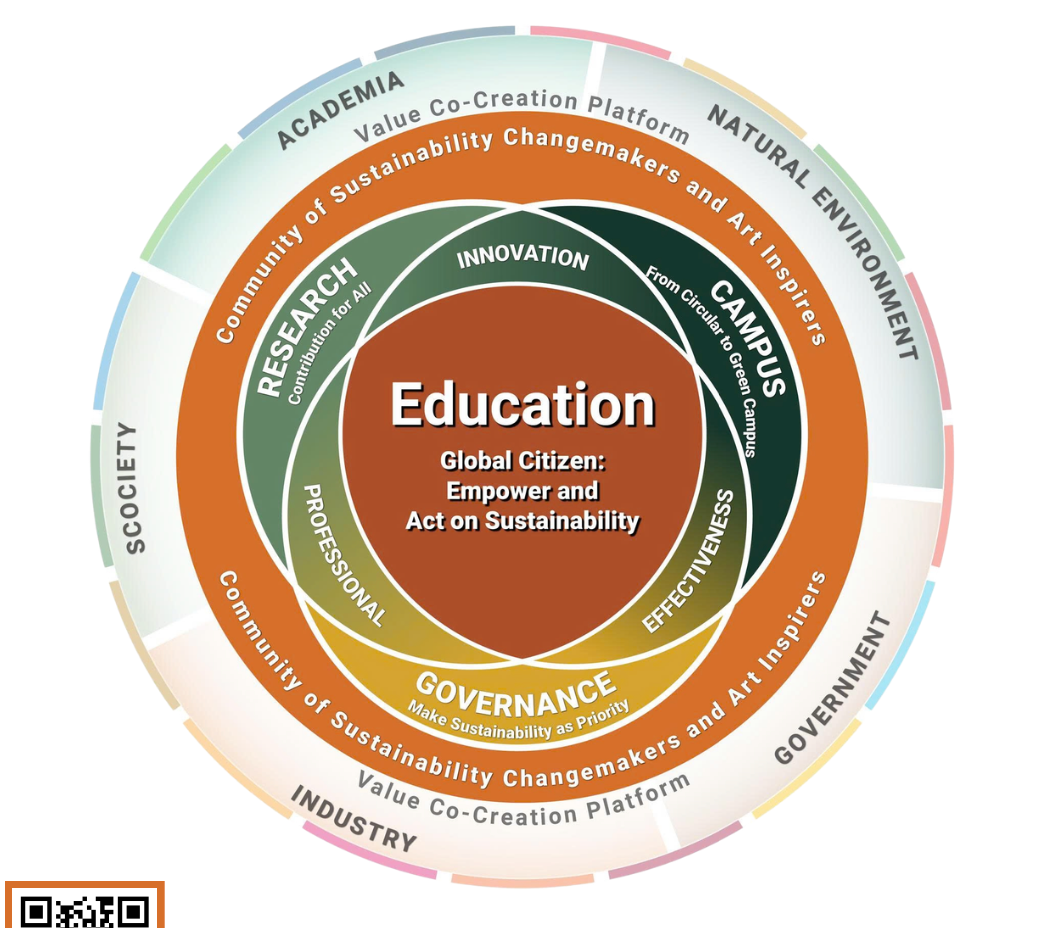
UEH's Multidisciplinary and Sustainable University Strategy integrates all 17 SDGs into five strategic pillars, placing the education of globally minded citizens capable of sustainable action at its core
UEH emphasized that these achievements have not resulted solely from large-scale policies or flagship programs but have been built through countless small, consistent actions: "Implementation creates data, execution delivers results, and persistence generates lasting impact," the UEH representative emphasized.
This philosophy has enabled UEH to embed the Sustainable Development Goals into its daily operations rather than treating them merely as reporting requirements for university rankings.
Reporting on All 17 SDGs: A Commitment to Comprehensive Sustainable Development
Rather than limiting its submission to the four SDGs required for calculating the overall score in the THE Impact Rankings, UEH proactively collects, standardizes, and reports data across all 17 Sustainable Development Goals.
Through this approach, UEH has become one of the few universities worldwide to comprehensively report on all 17 SDGs, demonstrating its commitment to pursuing sustainable development across every dimension.
This comprehensive strategy also provides a strong foundation for UEH to realize its ambition of becoming one of Vietnam's advanced higher education institutions within the leading group of Asian universities during the 2026–2035 period, in line with the national higher education development project recently approved by the Prime Minister of Vietnam and the Ministry of Education and Training.
Pillar: Education, Research, Governance, Operation, Community
News, photos: Department of Communications and Partnerships, Department of Research - Development and Global Engagement