Challenges and opportunities: Roads to sustainable fashion in Vietnam
27 Oct 2023
As the effects of environmental pollution become more apparent, young people are becoming more conscious of the importance of sustainability in consumer trends. As a result, sustainable fashion has recently become one of the most popular topics. Young consumers are becoming more interested in fabrics of natural origin and traditional materials and how to properly preserve clothing and limit waste. Growing demand for sustainable fashion among young people has created opportunities while posing challenges for this trend in Vietnam.
Read More
3R Practice Principles - Changing to become Green Citizens
29 Sep 2023
3R practices refer to three commonly used terms regarding waste reduction practices: Reduce, Reuse and Recycle in which Reduce is to reduce the amount of waste each individual creates; Reuse: find a way to reuse waste, not throw it away; Recycle: find new ways to use waste to create new products for life. With the message "Time for Go Green" of 2023, UEH wants to spread the habit of green life that is good for health and the environment to UEHers.
Read More
Waste sorting at UEH Go Green Station: Heading to a Green, Clean, Beautiful Campus
06 Sep 2023
Waste classification at UEH Go Green Station is one of the important activities within the UEH Green Campus Project 2023. According to this activity, any UEHers or visitors entering and leaving UEH need to comply with the principles of waste classification model 3 or model 7 located at UEH Campuses and Vinh Long Campus. Let’s learn how to classify waste at UEH Go Green Station.
Read More![[UEH Green Campus 2023] GreenDay series with the theme “GreenLife”: Changing perception - Mastering the future](/images/upload/img_background/ueh-bg-094625-052223.jfif)
[UEH Green Campus 2023] GreenDay series with the theme “GreenLife”: Changing perception - Mastering the future
17 May 2023
In two days, May 10 and 11, 2023, University of Economics Ho Chi Minh City (UEH) organized a series of Green Day activities with the theme "GreenLife" under the project "UEH Green Campus 2023". These activities aim to inspire and motivate students in particular and the community of participants in general in building a green lifestyle and sustainable learning, especially the right awareness of garbage classification.
Read More
Sustainable development trend: Green Marketing
31 Mar 2023
Consumers today have the opportunity to access more information thanks to the development of the Internet, so their decision-making process to buy products is also becoming more and more rigorous...
Read More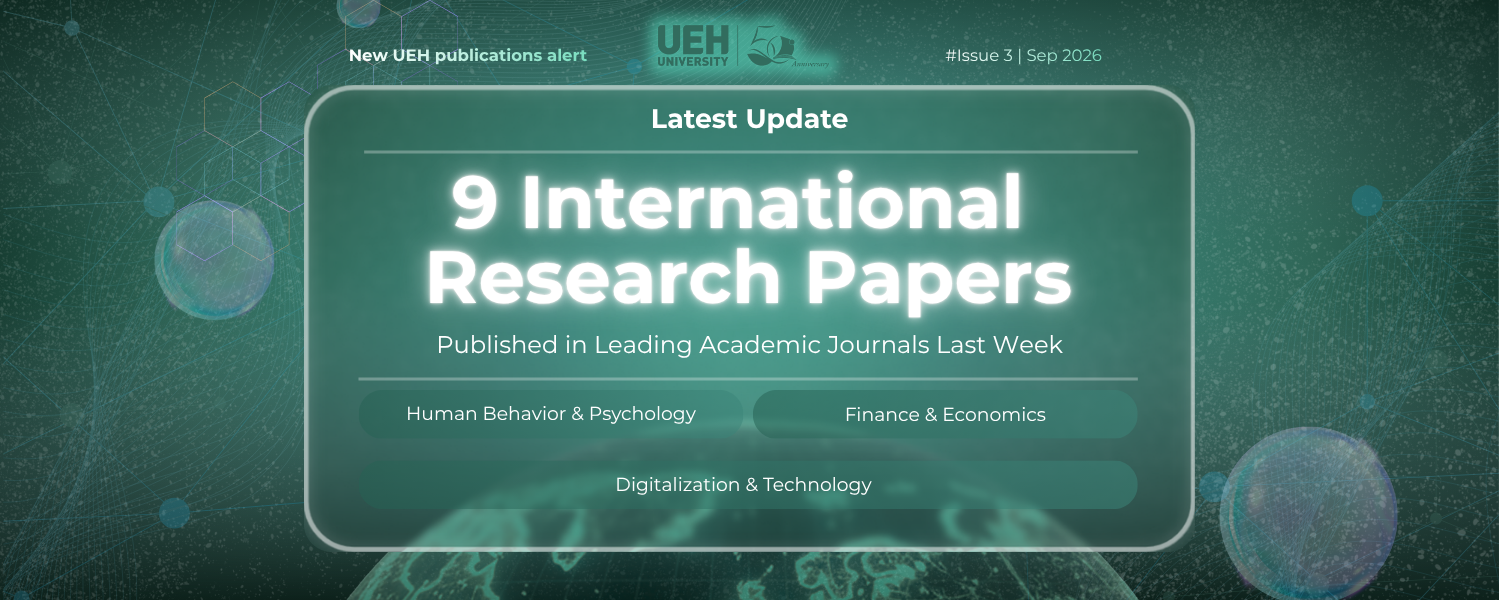
New UEH Publications Alert (Week 3 - September 2026): Decoding the Mechanisms Behind Behavioral Psychology, Artificial Intelligence, and Climate Finance
22 Sep 2026
In Week 3 - September 2026, the University of Economics Ho Chi Minh City (UEH) continues to record a series of new international publications, expanding its research focus from macro-level issues to the micro-level and “hidden mechanisms” that shape the behaviors of individuals, organizations, and systems. This week’s studies present an interdisciplinary research landscape in which global shocks, smart technologies, and environmental changes are examined through the lenses of finance, psychology, technology, law, and sustainable development.
Read More![Leadership skill discussion from one famous American Author - Professor. Allan R. Cohen - in the [Book Sharing] Unseen Leadership: Leading Without Authority event](https://en.ueh.edu.vn/images/upload/thumbnail/ueh-thumbnail-121609-110424.jpg)