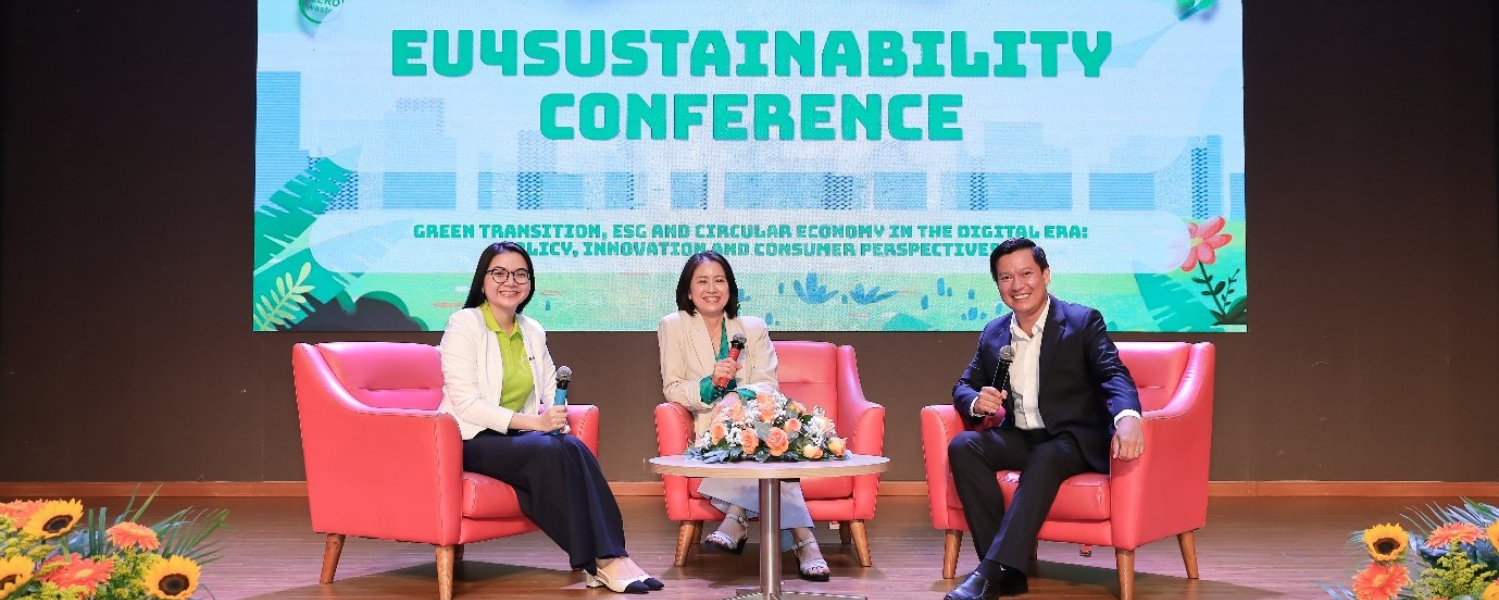
EU4Sustainability – A Three-Year Journey of Advancing Knowledge and Sustainable Development at UEH
09 Sep 2026
After three years of implementation, the Jean Monnet Module “Sustainable Development in the European Union: Jean Monnet Interdisciplinary Module” (EU4Sustainability) at the University of Economics Ho Chi Minh City (UEH) has successfully achieved significant milestones in education, academic research, and knowledge dissemination on sustainable development. Through interdisciplinary courses, annual scientific conferences, international publications, and community engagement activities, the project has contributed to bringing the European Union’s knowledge, policies, and practices on sustainable development closer to UEH students, academics, and the wider community.
Read More![[Research Contribution] Sustainable Tourism from a Behavioral Perspective: When Destination Choice Becomes an Ethical Pre-Trip Decision](/images/upload/img_background/ueh-background-639223335054299561.png)
[Research Contribution] Sustainable Tourism from a Behavioral Perspective: When Destination Choice Becomes an Ethical Pre-Trip Decision
14 Aug 2026
Sustainable tourism is not determined solely by how tourists behave upon arrival at a destination; it begins earlier—at the very moment they choose where to go. In a context where many destinations continue to face overtourism, pollution, and conflict with local communities, a team of researchers from the University of Economics Ho Chi Minh City (UEH) has approached sustainable tourism from the perspective of pre-trip behavior. Their study, published in the International Journal of Contemporary Hospitality Management, developed the “Ethically Minded Tourist Behavior” (EMTB) scale, designed to measure and promote responsible destination choices, thereby contributing to a more practical orientation toward sustainable tourism.
Read More
New UEH Publications Alert (Week 3 – July 2026): Interdisciplinary Convergence from ESG in Healthcare to Artificial Intelligence and Green Logistics
21 Jul 2026
In Week 3 – July 2026, the University of Economics Ho Chi Minh City (UEH) continued to record an outstanding series of international publications, reaffirming its expanding interdisciplinary research capacity. The latest studies demonstrate UEH's ability to integrate economics, management, technology, social sciences, and data science in addressing pressing issues related to digital transformation, sustainable development, corporate governance, and innovation.
Read More![[Green Monday Series] What does SDG 12 - Responsible Consumption and Production mean at UEH?](/images/upload/img_background/ueh-background-639195281843980100.png)
[Green Monday Series] What does SDG 12 - Responsible Consumption and Production mean at UEH?
13 Jul 2026
As natural resources continue to be depleted, the global population keeps growing, and millions of tonnes of food are wasted every year, transitioning toward responsible consumption and production has become essential to protecting the environment and ensuring human well-being. In alignment with SDG 12 - Responsible Consumption and Production, UEH is steadily turning this commitment into action through sustainable procurement policies, circular waste management practices, and the promotion of a culture of responsible consumption. In this week's Green Monday Series, let's explore UEH's efforts to build a more sustainable ecosystem for responsible consumption and production.
Read More![[Green Vibe Only] Protecting the Ocean Starts at UEH's Green Practice Station](/images/upload/img_background/ueh-background-639166811936966929.png)
[Green Vibe Only] Protecting the Ocean Starts at UEH's Green Practice Station
10 Jun 2026
Did you know that the straw or plastic cup you casually toss away today could very well end its life somewhere in the ocean? Plastic waste from land is one of the primary drivers of marine ecosystem degradation. According to data from the Ho Chi Minh City Department of Natural Resources and Environment, the city generates approximately 9,000 tonnes of household waste every day, of which plastic waste accounts for roughly 1,800 tonnes. Without proper source separation and risk control, large quantities of non-biodegradable waste will infiltrate the city's canal systems, leak into the ocean, and directly disrupt underwater ecological chains.
Read More![[Final Round of the Gen Z & ESG: Promoting Sustainable Development 2026 Competition] The Rise of the Young Generation in Building a Sustainable Future](/images/upload/img_background/ueh-background-639173109711710854.jpg)
[Final Round of the Gen Z & ESG: Promoting Sustainable Development 2026 Competition] The Rise of the Young Generation in Building a Sustainable Future
18 May 2026
On May 17, 2026, the inspiring journey of the Gen Z & ESG: Promoting Sustainable Development 2026 (ZESG 2026) competition, organized by the Sustainable Finance Institute (SFI) under the University of Economics Ho Chi Minh City (UEH), officially came to a close. The Final round was a resounding success, leaving many deep impressions and affirming the role of the younger generation in implementing ESG values.
Read More![Leadership skill discussion from one famous American Author - Professor. Allan R. Cohen - in the [Book Sharing] Unseen Leadership: Leading Without Authority event](https://en.ueh.edu.vn/images/upload/thumbnail/ueh-thumbnail-121609-110424.jpg)