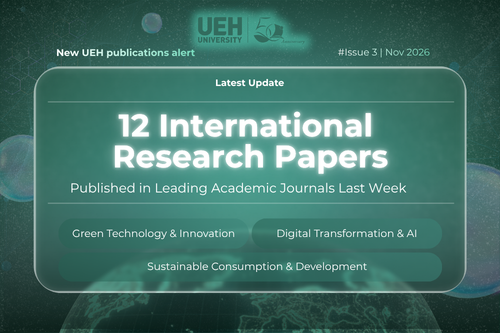
New UEH Publications Alert (Week 3 – November 2026): Uncovering How Technology and Institutions Are Transformed into Sustainable Value
26 Nov, 2026
In Week 3 of November 2026, the University of Economics Ho Chi Minh City (UEH) continued to record new international publications, focusing on how technology, institutions, and organizational capabilities are translated into sustainable value in practice. The studies span supply chain transparency, green technology commercialization, energy policy simulation, corporate governance, autonomous systems, and human–machine collaboration. A common thread across these works is the effort to identify the conditions and mediating mechanisms that determine the effectiveness of innovation, rather than focusing solely on technology adoption or policy formulation.
Building Environmental Trust and Transforming Consumer Behavior
Addressing information asymmetry in the green products market, this week's studies focus on how traceability technologies, communication, and consumer experiences contribute to building trust and promoting responsible choices:
- - Blockchain in Supply Chains and Sustainable Consumption: A review of Blockchain-enabled traceability reveals the technology's potential to serve as an infrastructure for strengthening the transparency and reliability of sustainability information. By supporting the verification of product attributes and enhancing coordination among supply chain stakeholders, Blockchain can help reduce information asymmetry and strengthen consumer trust. The study also synthesizes research trends and outlines future directions at the intersection of Blockchain and sustainable consumption.
- - Green Technology Commercialization: Beyond technology development, transforming green solutions into social benefits also depends on their commercialization and widespread adoption. Through a bibliometric review, this study maps the knowledge structure and the evolution of the green technology commercialization field over time, while identifying barriers such as policy uncertainty, financial constraints, and infrastructure limitations. This provides a basis for identifying the conditions needed to translate technological innovations from research into practical applications.
- - Green Marketing and the Boundaries of Greenwashing: Drawing on the Hierarchy of Effects (HOE) theory, this study examines how exposure to green advertising influences purchase intentions through brand image and brand trust, while also considering the moderating role of perceived greenwashing. The findings approach environmental communication from a trust-based perspective: green messages must not only capture attention but also build a credible brand image and overcome consumer skepticism.
- - Local Culinary Experiences and Gen Z Satisfaction: Surveying 342 Gen Z diners in Vietnam, this study combines symmetrical and asymmetrical analytical methods to examine the relationships among restaurant quality, price fairness, authenticity, and satisfaction. It highlights the role of perceived authenticity in ethnic dining experiences, broadening the understanding of service value: satisfaction is shaped not only by food and service quality but also by cultural value and local experiences.
Corporate Governance, Macroeconomic Policies, and Energy Challenges
From policy formulation to corporate operations, this week's studies provide quantitative insights into how financial resources, institutional pressures, and management capabilities influence sustainable development goals:
- - Energy Policy Simulation Using a Recursive-Dynamic CGE Model: This study evaluates the economic impacts of renewable energy policies in Vietnam using a Recursive-dynamic Computable General Equilibrium (CGE) model, calibrated using the 2022 Social Accounting Matrix and simulated annually through 2030. Rather than treating energy and climate targets as independent indicators, the study examines policy scenarios within the interactions of the broader economy, thereby providing an analytical basis for policy choices that simultaneously advance SDG 7 – Affordable and Clean Energy and SDG 13 – Climate Action.
- - Environmental Management Accounting (EMA) and Eco-Innovation in SMEs: Focusing on small and medium-sized manufacturing enterprises, this study analyzes how institutional pressures – including coercive, normative, and mimetic pressures – drive the adoption of Environmental Management Accounting (EMA). It then examines EMA's role in promoting three forms of eco-innovation: product, process, and organizational innovation. The study clarifies how environmental management capabilities help translate external pressures into concrete changes in business operations.
- - ESG Accountability and Corporate Value Creation: Beyond disclosing environmental, social, and governance commitments, companies need to translate these commitments into verifiable practices. This study of listed companies in Southeast Asia focuses on the relationships among ESG disclosure, Integrated Reporting Quality, and value creation. It highlights the role of reporting quality and accountability in connecting ESG commitments with organizational practices.
- - Cost Stickiness amid Macroeconomic Uncertainty: Analyzing data from listed companies in Vietnam, this study examines the relationship between macroeconomic uncertainty and cost stickiness – a phenomenon in which costs do not decrease proportionately when revenue declines. This topic sheds light on how managers adjust resources in response to changes in the business environment, offering insights into decisions to maintain or reduce costs under conditions of uncertainty.
The Era of Autonomy, Artificial Intelligence, and Human–Machine Collaboration
Technology publications continue to expand the scope of research, from predicting the movements of autonomous systems to applying AI in knowledge management and human–robot collaboration. A common theme is the focus on the conditions under which technology can support people and improve decision-making effectiveness:
- - UAV Trajectory Forecasting Using a Hybrid Diffusion-Based World Model: This study proposes a hybrid world model using diffusion algorithms to forecast the short-term trajectories of unmanned aerial vehicles (UAVs) and probabilistically estimate collision risks in dense three-dimensional environments. Rather than predicting a single movement path, the model aims to represent multiple possible future trajectories while assessing the safety implications of each scenario. This approach is significant for developing autonomous systems that require predictive capabilities and risk assessment.
- - AI Chatbots in Knowledge Management and Sustainable Luxury Fashion Consumption: This study analyzes how AI chatbot-enabled knowledge management activities – through knowledge acquisition, sharing, and application processes – influence sustainable luxury fashion consumption behavior. It also examines the moderating role of consumers' need for uniqueness, clarifying how psychological characteristics can affect the process of translating knowledge and attitudes into consumer behavior.
- - Human–Robot Collaboration in Strategic Decision-Making in the Public Sector: This study examines Human–Robot Collaboration (HRC) in the context of strategic decision-making within public sector organizations. In particular, it investigates the moderating role of organizational collaborative culture in the relationship between HRC and decision-making processes. This approach highlights that the effectiveness of robot applications depends not only on technological capabilities but also on the organizational environment and the ability of people to coordinate with intelligent systems.
- - Innovating Public Sector Accounting Education through Digital Art: This study examines the relationship between Digital Art Implementation and sustainable development-oriented public sector accounting education outcomes. Notably, lecturers' Emotional Intelligence (EI) is incorporated as a moderating factor in the research model. The study suggests that the effectiveness of educational technology depends not only on the tools being deployed but also on lecturers' ability to interact with and support learners.
From Technological Innovation to the Capacity to Create Sustainable Value
The diversity of publications in Week 3 of November 2026 is reflected in the combination of various research methods, including bibliometric reviews, dynamic computable general equilibrium models, symmetrical and asymmetrical analyses, mediation–moderation modeling, and deep learning algorithms. These approaches broaden perspectives on how technology, institutions, and organizational capabilities can be translated into tangible outcomes.
By connecting challenges ranging from supply chain transparency, energy policy, and corporate governance to autonomous systems, education, and human–machine collaboration, these studies continue to contribute interdisciplinary knowledge for businesses, policymakers, and communities. This approach also helps strengthen UEH's multidisciplinary research foundation, connecting international knowledge with practical issues in Vietnam and the region.
List of Publications This Week
For ease of reference and citation in international journals, the article titles in the list below are retained in their original English.
- Blockchain-Enabled Traceability for Sustainable Consumption: Themes, Trends and a Research Agenda
Authors: Khanh Huy Nguyen, An Khang Trinh, Mai Dong Tran
Journal: International Journal of Consumer Studies, WOS (SSCI Q1) - Green technology commercialization: Drivers, barriers, and emerging directions
Authors: Phuoc Hung Thach, Mai Dong Tran, Khanh Huy Nguyen
Journal: Social Sciences and Humanities Open, Scopus Q1 - Understanding How Green Advertising Promotes Sustainable Consumption: The Mediating Effects of Brand Trust and Brand Image, and the Role of Greenwashing as a Moderator
Authors: Van Tinh Hoang, Thi Phuong Linh Le, Huu Phuc Dang
Journal: International Journal of Business Science and Applied Management, Scopus Q2 - From restaurant quality to Gen Z diner satisfaction in ethnic dining: Insights from linear and configurational approaches
Authors: Hoang-Phuong Lam, Tien Hung Nguyen, Duc-Minh Doan
Journal: Acta Psychologica, WOS (SSCI Q1) - Renewable energy policy, financing mechanisms, and structural change in Vietnam: A CGE analysis of SDG 7 and SDG 13 pathways
Authors: Tung Duy Bui, Hoai Thi Mai Bui, Khang Sy Dinh
Journal: Heliyon, WOS (SCIE Q1) - Institutional Pressures, Environmental Management Accounting, Eco-Innovation, and Pollution Reduction in SMEs
Authors: Pham Thi Kim Thanh, Nguyen Thanh Tai, Tran Thi Thanh Hai, Nguyen Le Ha Than Na, Nguyen Ha Thach
Journal: World Journal of Environmental Biosciences, Scopus Q2 - From AI chatbot-enabled knowledge management to sustainable luxury consumption: the moderating role of need for uniqueness
Authors: Thong Minh Phan and Nhi Khanh Thi Ngo, Ngoc Bao Mai Pham
Journal: Asia Pacific Journal of Marketing and Logistics, WOS (SSCI Q2) - A Hybrid Diffusion World Model for UAV Trajectory Forecasting and Collision Risk Estimation in Dense 3D Environments
Authors: Bao Nguyen, Ngan Nguyen Xuan Phuong
Journal: Intelligent Automation & Soft Computing, Scopus Q1 - The Accountability Pathway: Linking ESG Disclosure, Integrated Reporting Quality, and Value Creation in Southeast Asia
Authors: Nha Minh Nguyen, Malik Abu Afifa, Duong Van Bui, Hien Vo Van, Dao Truc Thi Vo
Journal: Corporate Social Responsibility and Environmental Management, WOS (SSCI Q1) - Macroeconomic uncertainty and cost stickiness: evidence from Vietnam
Authors: Anh Tu Pham, Tri Tri Nguyen, Hai Hong Phan
Journal: Journal of Financial Reporting and Accouting, Scopus Q1 - Opening doors: Digital art in public sector accounting education for sustainable development
Authors: Pham Quang Huy, Vu Kien Phuc
Journal: Acta Psychologica, WOS (SSCI Q2) - Intelligence and Effectiveness? An Empirical Analysis of Human–Robot Collaboration for Strategic Decision-Making in Public Sector Entities
Authors: Pham Quang Huy, Vu Kien Phuc
Publication type: Book chapter
View the Week 3 – November 2026 Publications List at:
https://news.ueh.edu.vn/2026/scientist/W3Nov.html
View the complete New UEH Publications Alert for 2026 at:
https://news.ueh.edu.vn/en/scientist
The New UEH Publications Alert series will continue to provide weekly updates on UEH's latest international publications. Faculty members, alumni, and learners are warmly invited to follow the series and join us in advancing the spirit of “Research Contribution for All”.
Pillar: Research
Text and photos: Department of Research - Development and Global Engagement; Deparment of Communications and Partnerships