
![[UEH 50] National Forum on English-Medium Instruction (EMI) 2026: Advancing the Internationalization Strategy of Vietnamese Higher Education](/images/upload/img_background/ueh-background-639280172883934121.png)
[UEH 50] National Forum on English-Medium Instruction (EMI) 2026: Advancing the Internationalization Strategy of Vietnamese Higher Education
19 Oct 2026


As part of the key events leading up to the 50th anniversary of the University of Economics Ho Chi Minh City (UEH50), UEH organized the 2026 National Forum on English-Medium Instruction (EMI) on October 17, 2026. Themed “English-Medium Instruction: A Strategic Driver for Vietnam’s National English as a Second Language Initiative,” the Forum aimed to facilitate discussions on policy directions, international experience, and the conditions necessary for the effective and sustainable implementation of EMI in Vietnamese higher education.
Read More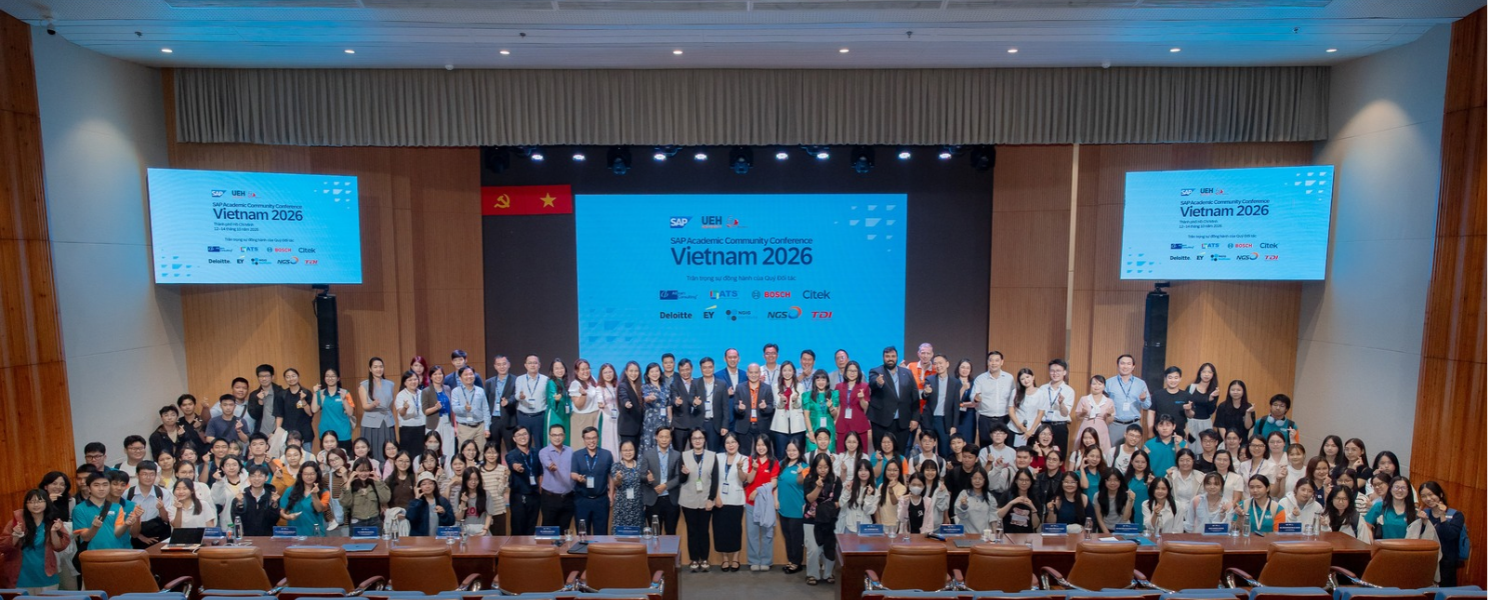
SAP Vietnam Academic Community Conference 2026: Advancing Multilateral Cooperation to Develop Digital Talent in the AI Era
17 Oct 2026
From October 12 to 14, 2026, the University of Economics Ho Chi Minh City (UEH), in collaboration with SAP, organized the 2026 SAP Vietnam Academic Community Conference under the theme “Learning and Teaching for the Age of Autonomous Enterprise.” The Conference brought together more than 200 delegates from government agencies, higher education institutions, SAP, and the business community to explore emerging technology trends and discuss solutions for strengthening collaboration among the Government, Academia, and Business.
Read More![[UEH 50 Years] Proudly Looking Ahead to UEH’s 50th Anniversary Celebration and the Conferment of the First-Class Labor Order](/images/upload/img_background/ueh-background-639277641435127907.jpg)
[UEH 50 Years] Proudly Looking Ahead to UEH’s 50th Anniversary Celebration and the Conferment of the First-Class Labor Order
16 Oct 2026
At 8:00 a.m. on October 28, 2026, the University of Economics Ho Chi Minh City (UEH) will solemnly hold the 50th Anniversary Celebration of its establishment (October 27, 1976 – October 27, 2026) and receive the First-Class Labor Order. The event marks a special moment in UEH’s half-century journey of development, bringing together pride in its achievements, gratitude to the generations who have contributed, and aspirations to reach new heights in the journey ahead.
Read More![[Research Contribution] Determinants of Early Retirement Intentions: A Psychological, Social, and Workplace Perspective](/images/upload/img_background/ueh-background-639277586737227333.png)
[Research Contribution] Determinants of Early Retirement Intentions: A Psychological, Social, and Workplace Perspective
16 Oct 2026


Khi dân số già hóa và thị trường lao động không ngừng thay đổi, nghỉ hưu sớm ngày càng trở thành vấn đề được quan tâm bởi những tác động đến nguồn cung lao động, phúc lợi cá nhân và tính bền vững của lực lượng lao động. Nhưng điều gì thực sự thúc đẩy một người lựa chọn nghỉ hưu sớm? Liệu quyết định này chỉ xuất phát từ tài chính và sức khỏe, hay còn chịu ảnh hưởng bởi áp lực gia đình, môi trường làm việc và những yếu tố tâm lý, xã hội? Xuất phát từ thực tiễn này, nhóm nghiên cứu thuộc UEH Mekong, Đại học Kinh tế Thành phố Hồ Chí Minh (UEH) đã phân tích các yếu tố tâm lý, xã hội và nơi làm việc góp phần hình thành ý định nghỉ hưu sớm.
Read More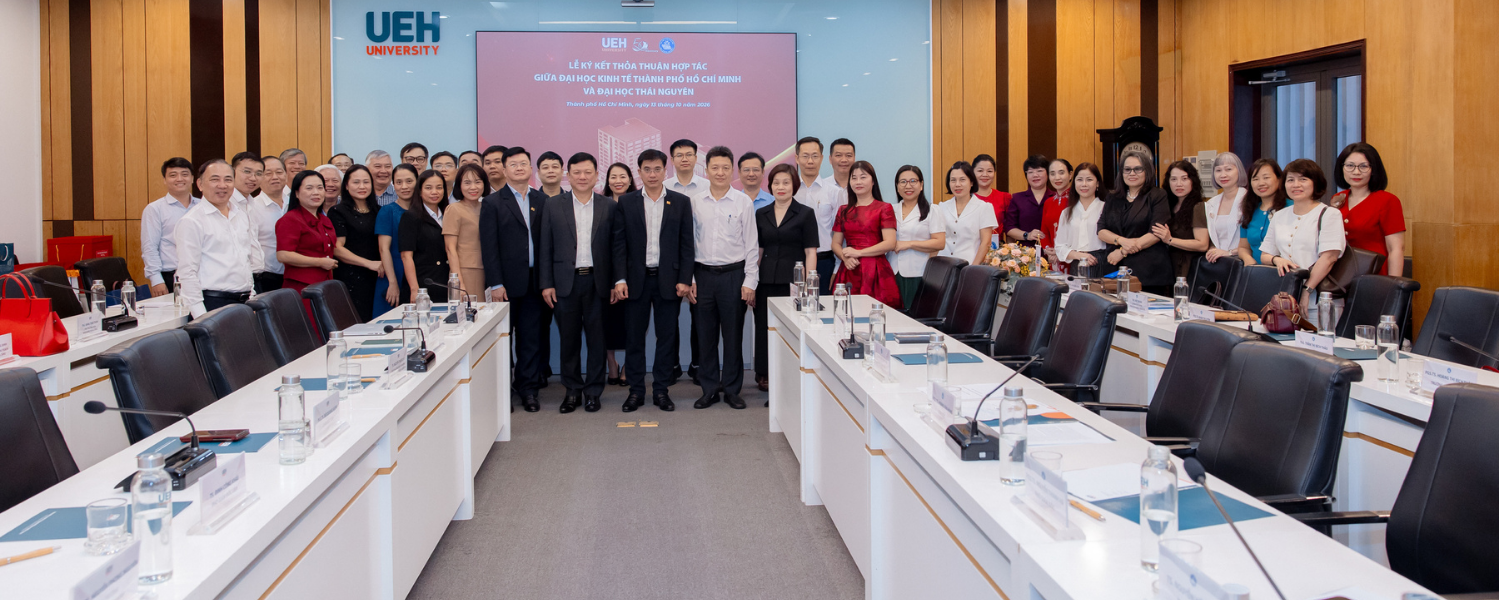
UEH and Thai Nguyen University strengthen connectivity and expand cooperation in education, scientific research, and digital transformation
15 Oct 2026

On the afternoon of October 13, 2026, the University of Economics Ho Chi Minh City (UEH) welcomed, worked with, and signed a cooperation agreement with Thai Nguyen University, aiming to strengthen connectivity and share experiences in university governance, education, scientific research, innovation, and digital transformation. Both sides also agreed on key cooperation orientations, scheduled for implementation starting in 2027.
Read More
UEH Dream Concert 2026: Registration now open for a special symphony concert
15 Oct 2026
In celebration of the 50th anniversary of the University of Economics Ho Chi Minh City (UEH) (1976-2026), UEH Dream Concert 2026 is a special artistic program that honors the University’s five-decade journey of establishment and development through the language of music, while fostering cultural and artistic connections between Vietnam and the international community.
Read More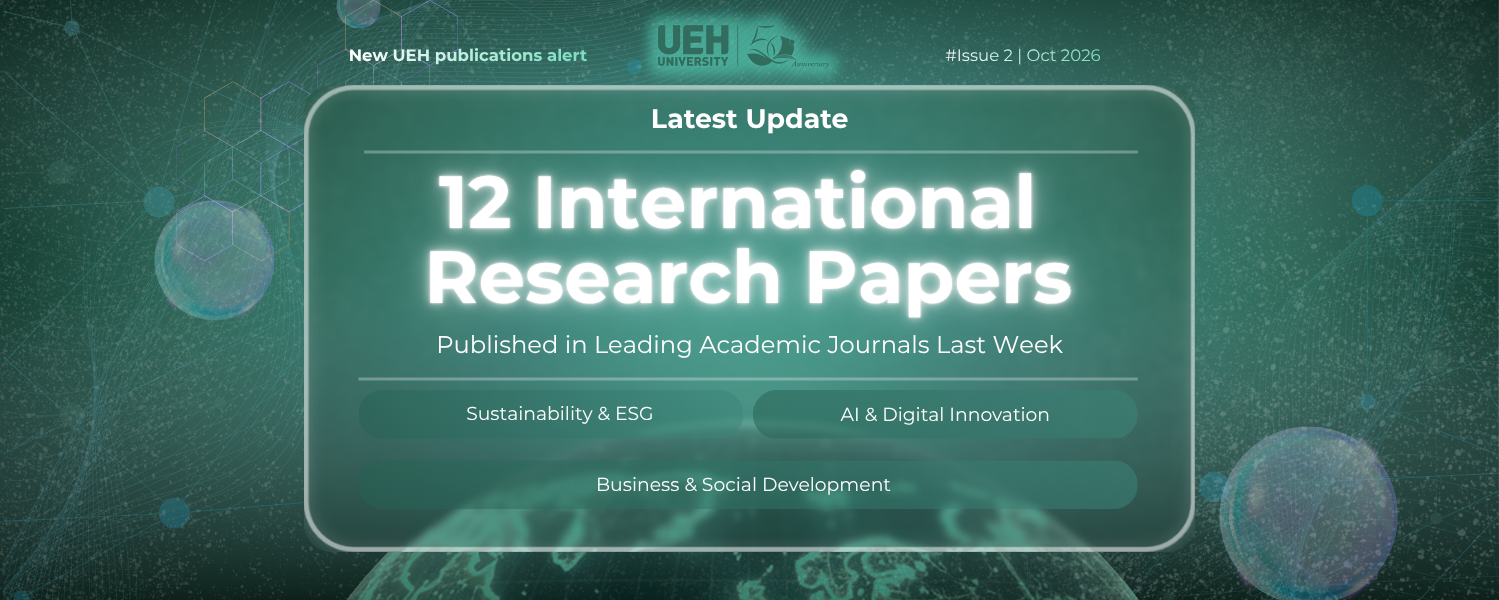
New UEH Publications Alert (Week 2 – October 2026): Integrating Digital Technology into the Core of Governance, Institutions, and Sustainable Development
14 Oct 2026

In Week 2 of October 2026, the University of Economics Ho Chi Minh City (UEH) continued to record numerous new international publications, expanding its research scope from corporate competitiveness, organizational behavior, and educational innovation to cybersecurity, energy policy, and legal-institutional power. This week’s studies show that digital technology and artificial intelligence (AI) are no longer merely supporting tools but are increasingly intertwined with the core structures of governance, socio-economic systems, and sustainable development.
Read More
UEH Shares Its Model of an Innovation-Driven University and Expands Partnership Networks in Japan
14 Oct 2026
From October 4 to 9, 2026, a delegation from the University of Economics Ho Chi Minh City (UEH), comprising Assoc. Prof. Bui Quang Hung, President of UEH, and Assoc. Prof. Pham Khanh Nam, Head of the Research, Development and Global Engagement Department, visited Japan on a working mission. Through participation in the STS Forum 2026, the 4th Japan–Vietnam Rectors’ Conference, and meetings with university partners, the delegation shared UEH’s development vision, exchanged experience in university governance, and explored opportunities for collaboration in education, research, and innovation.
Read More![[UEH CONFERENCE 50] UEH Hosts SR-ICYREB 2026, Advancing Student Research and Nurturing the Next Generation of Young Scholars](/images/upload/img_background/ueh-background-639273984608822791.png)
[UEH CONFERENCE 50] UEH Hosts SR-ICYREB 2026, Advancing Student Research and Nurturing the Next Generation of Young Scholars
12 Oct 2026
On October 9-10, 2026, the University of Economics Ho Chi Minh City (UEH) hosted the 5th International Conference for Students on Scientific Research in Economics and Business (SR-ICYREB 2026), bringing together students from 11 universities and academies. Of more than 350 submissions received, 293 papers were selected for publication, expanding academic opportunities for emerging researchers as part of the series of activities leading up to UEH’s 50th anniversary.
Read More![[UEH 50 Years] UEH50 Global Leadership Forum 2026: Connecting Global University Leaders to Shape a Sustainable Future for Higher Education](/images/upload/thumbnail/ueh-thumbnail-639287195725926552.png)
![[UEH 50 Years] A Multidisciplinary and Sustainable University: A strategic transformation to expand the frontiers of knowledge and create value for the community](/images/upload/thumbnail/ueh-thumbnail-639286299966128227.png)
![[UEH 50] Launching Ceremony UEH Technology Convergence Hub and UEH FLEX Pilot Project: A Convergence Point for Technology, Knowledge Connection, and Innovation for Sustainable Development](/images/upload/thumbnail/ueh-thumbnail-639286062840222030.png)
![[UEH 50] JABES Launches Special Issue Celebrating the 50th Anniversary of UEH: 12 Research Papers Accompanying Vietnam's Development Issues](/images/upload/thumbnail/ueh-thumbnail-639283721313299577.png)
![[UEH Through the Lenses of Time #01] UEH 50 Years: From the Classroom Window to the Aspiration to Contribute](/images/upload/thumbnail/ueh-thumbnail-639282664984784994.png)