
The Economy and Environment Partnership for Southeast Asia (EEPSEA): Connecting science, policy, and action for sustainable development The Economy and Environment Partnership for Southeast Asia (EEPSEA)
30 Jan, 2026
As Southeast Asian cities face mounting pressure from pollution and the overexploitation of natural resources, the Economy and Environment Partnership for Southeast Asia (EEPSEA) at the University of Economics Ho Chi Minh City (UEH) goes beyond the boundaries of academic research to actively connect science, policy, and real-world action. In addition to scientific research projects, EEPSEA helps shape development pathways that address critical environmental challenges in Vietnam and across Southeast Asia.
From research partner to strategic advisor
The year 2025 marked a significant transition for the Economy and Environment Partnership for Southeast Asia (EEPSEA) - from a research partner to a strategic advisor for development programs. Through its independent impact evaluations of The Newton Fund in Vietnam and Thailand, EEPSEA has provided quantitative analyses and policy lessons to support governments and donors in refining the design and implementation of science and technology programs in subsequent phases.
At the same time, EEPSEA has continued to expand its international collaboration network with reputable partners, such as The Swedish International Development Cooperation Agency (SIDA), the Danish International Development Agency (DANIDA), and other global research institutions. Research themes span a wide range, from renewable energy (REturn project) to rural structural transformation, illustrating EEPSEA’s consistent commitment to addressing critical development challenges in the region.
Bringing Southeast Asian knowledge into global agendas
Through the Blue Resources for Development (BlueRforD) program, EEPSEA has brought field-based research findings from Vietnam to The 2025 United Nations Ocean Conference in Nice, France, contributing Southeast Asian perspectives to global discussions on marine resource governance. At the regional level, the international conference “Ocean Futures: Smart Technologies and Sustainable Coastal Living”, held in Khanh Hoa Province, has served as an important academic dialogue platform on technology, coastal livelihoods, and marine spatial planning - fostering stronger linkages between knowledge, policy, and communities.
.png)
UEH is a member of the Blue Resources for Development (BlueRforD) program - a global research collaboration network dedicated to the sustainable management and use of water resources
.png)
The international conference “Ocean Futures: Smart Technologies and Sustainable Coastal Living”, held in Khanh Hoa Province
Across national and international conferences, EEPSEA remains steadfast in its vision that local and regional knowledge forms the core foundation for shaping and implementing sustainable development agendas.
Investing in People and Expanding the Frontiers of Knowledge
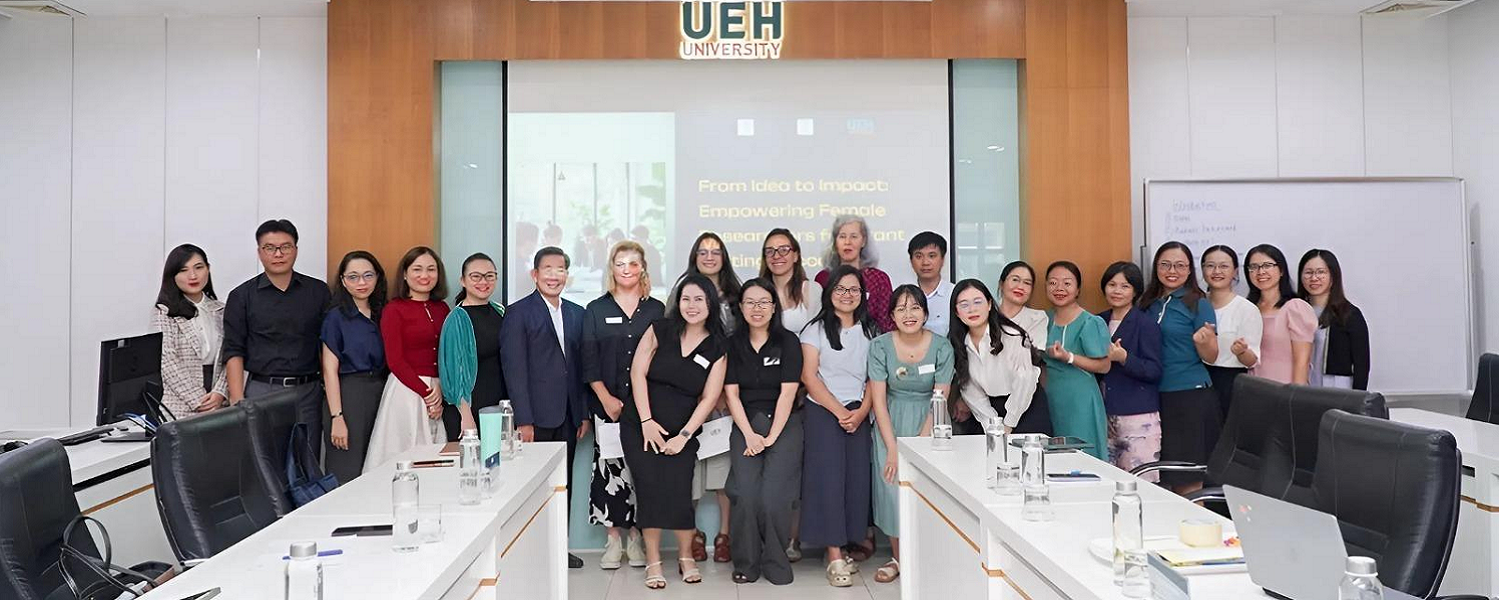
Identifying people as the “operating system” of all transformations, EEPSEA is strongly focused on training and developing research capacity in 2025. In collaboration with the World Bank, EEPSEA organized a series of intensive workshops on Computable General Equilibrium (CGE) modeling for climate change analysis, combining online training with in-person sessions at UEH. In parallel, through cooperation with Women in Environment Economics for Development (WinEED), EEPSEA successfully organized the workshop “From Idea to Impact”, supporting female researchers in transforming ideas into competitive funding proposals.
.png)
In addition, the EEPSEA has proactively expanded into new research frontiers, ranging from urban heat resilience among vulnerable workers in Ho Chi Minh City and Jakarta, to low-emission logistics connecting the Mekong region, and the impacts of low-carbon rice systems on health and climate. These directions demonstrated that EEPSEA not only keeps pace with emerging issues but also takes the lead in posing forward-looking questions for the region’s sustainable development future.
Vision for 2026: From “Good Research” to “Greater Impact”
Entering 2026, EEPSEA will shift its focus from expanding activities to enhancing depth and impact. The Institute will optimize the management model of the BlueRforD program, concentrate resources on research support tools and seed funding to nurture breakthrough ideas from their earliest stages, and strengthen the application of advanced analytical tools to narrow the gap between data, research, and policy recommendations. The ultimate goal is to transform academic reports into more accessible data-driven narratives for policymakers and the wider public.
Aligned with UEH’s sustainable development orientation, the Economy and Environment Partnership for Southeast Asia (EEPSEA) is not only a hub for Southeast Asian knowledge but also a space where that knowledge is translated into responsible decisions for the present and the future. Guided by the belief that research only truly matters when it improves real lives, EEPSEA will continue to catalyze the flow of knowledge, contributing to a greener, more inclusive, and more sustainable future for Viet Nam and Southeast Asia./.
New, photos: Economy and Environment Partnership for Southeast Asia (EEPSEA)
![[UEH 50] JABES Launches Special Issue Celebrating the 50th Anniversary of UEH: 12 Research Papers Accompanying Vietnam's Development Issues](/images/upload/thumbnail/ueh-thumbnail-639283721313299577.png)
![[UEH Through the Lenses of Time #01] UEH 50 Years: From the Classroom Window to the Aspiration to Contribute](/images/upload/thumbnail/ueh-thumbnail-639282664984784994.png)
![[UEH Through the Lenses of Time #02] School of Mathematics - Statistics: Generations of Deans and the Journey of Continuation](/images/upload/thumbnail/ueh-thumbnail-639282663344912443.png)
![[UEH Through the Lenses of Time #03] Half a Century, A Journey & Hundreds of Thousands of Hearts](/images/upload/thumbnail/ueh-thumbnail-639282661905215411.png)
![[UEH Through the Lenses of Time #04] Simple Frames: Keepsakes, Teachers, and Everyday Memories of Generations of UEHers](/images/upload/thumbnail/ueh-thumbnail-639282660641392168.png)