
THE RANKINGS: UEH LEADS VIETNAMESE UNIVERSITIES, SUSTAINS ITS TOP 250 ASIA GOAL FOR THE 2025-2030 PERIOD
23 Apr, 2026

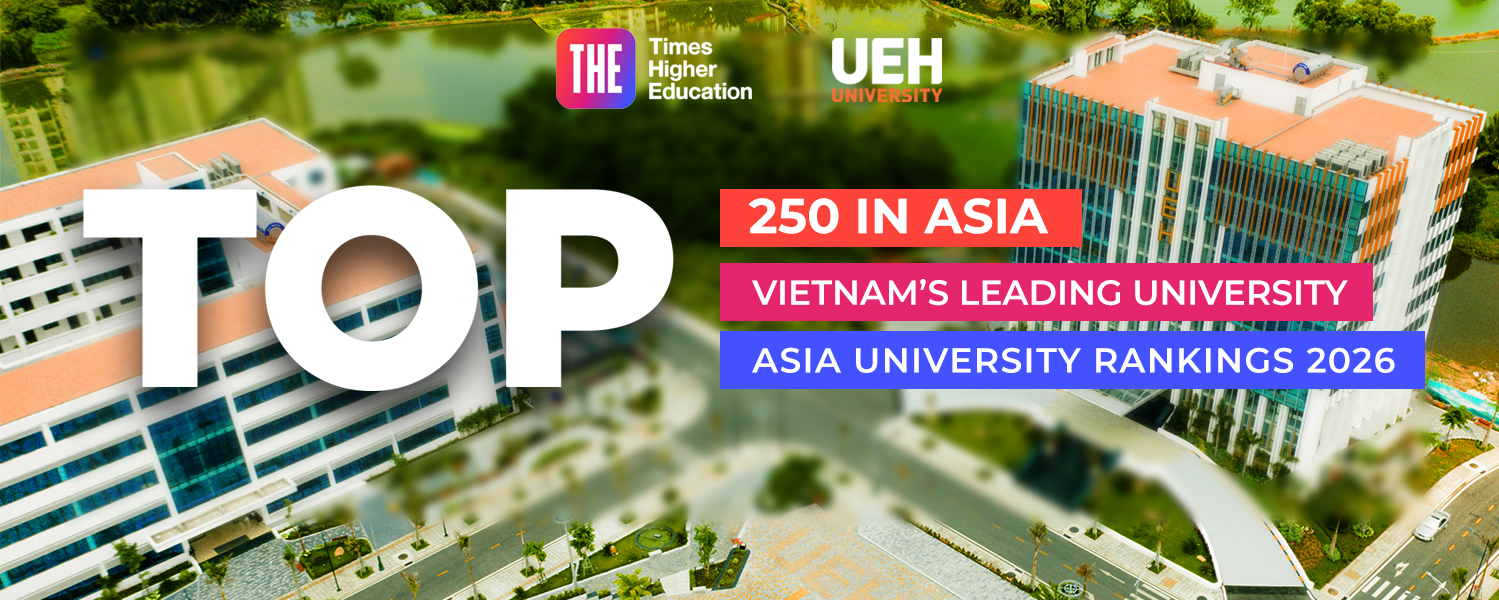
According to the official announcement by Times Higher Education, the University of Economics Ho Chi Minh City (UEH) is ranked 184th in the THE Asia University Rankings 2026, leading 11 Vietnamese universities and continuing to maintain its position among the Top 250 universities in Asia.
This result is positioned within UEH’s overall stability across major international rankings, including THE, QS, and sustainability-focused university rankings (THE Impact, QS Sustainability, and UI GreenMetric).
Previously, UEH maintained its position in the Top 501+ universities worldwide in the THE 2026 rankings, staying on track toward its goal of reaching the Top 250 in Asia by 2030 through a well-structured ranking management strategy. At the same time, the university achieved positive outcomes in subject rankings, placing in the Top 301–400 globally for Business and Economics and Top 401+ for Social Sciences.
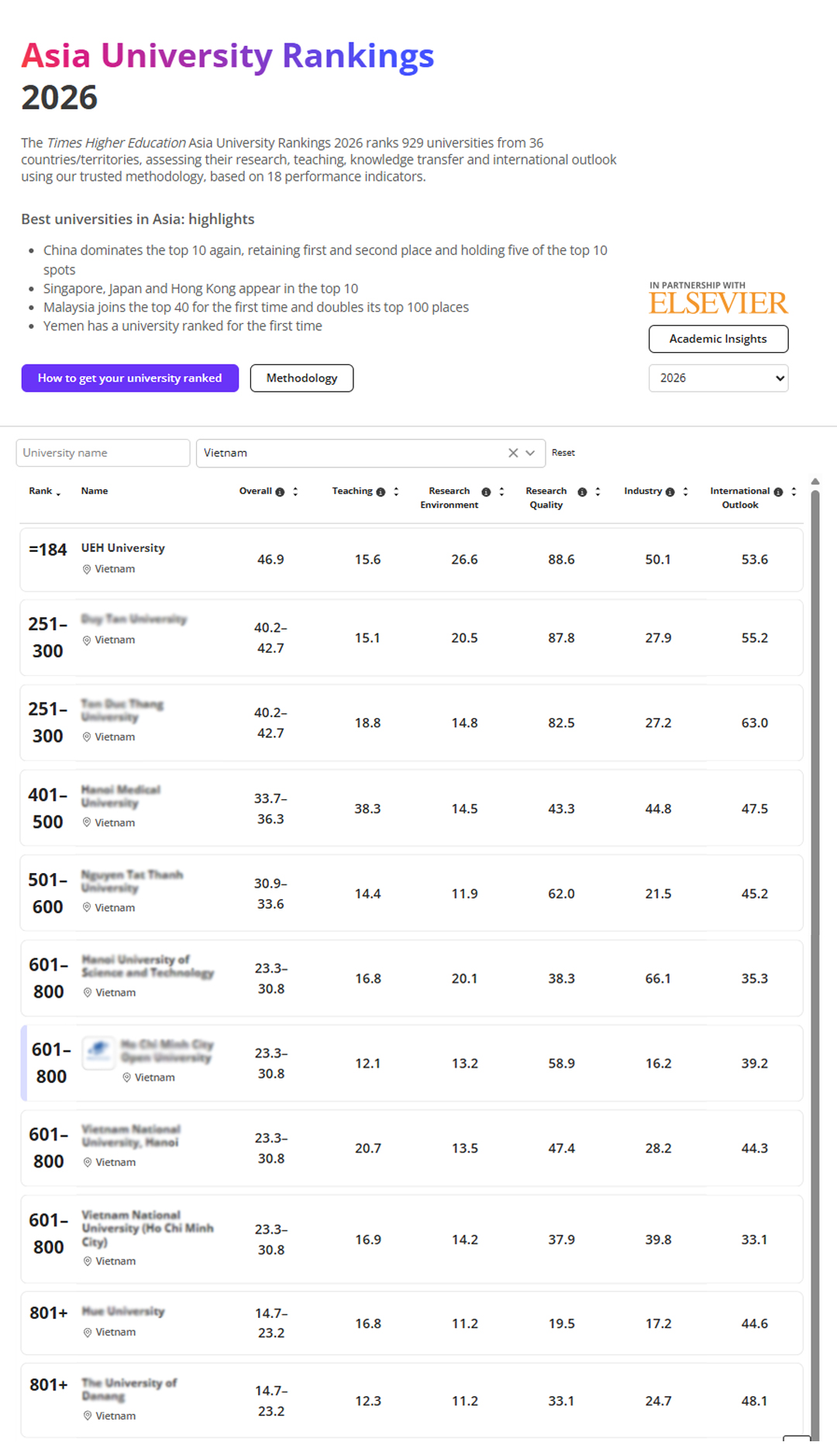
UEH leads Vietnamese universities, maintaining its position in the Top 250 universities in Asia in 2026
Strengthening academic standing through core criteria and areas of strength
The THE Asia University Rankings are based on five performance pillars: Teaching (24.5%), Research Environment (28%), Research Quality (30%), International Outlook (7.5%), and Industry Income (10%).
UEH recorded several notable highlightst:
- Research Quality reached a score of 88.6, approaching the level of leading universities worldwide. This pillar addresses questions such as: Are the University’s publications highly cited? Do they belong to the global academic elite? Do they contribute to major scientific challenges?
- International Outlook increased by +5.1 points, from 48.5 to 53.6, surpassing the median and approaching the top 75% globally. This pillar addresses questions such as: Does the University attract international faculty and students? Does it engage in cross-border research collaboration? Is it globally oriented or primarily domestic?
- Industry Income reached 50.1, remaining above the median, reflecting strong engagement with industry and effective knowledge transfer. This pillar addresses questions such as: Do businesses seek partnerships? Is research applied in practice? Does it generate economic and social impact?
Challenges in Maintaining Ranking Position Amid Intensifying Competition in Asia with Nearly 80 New Entrants
The 2026 rankings reflect a strong rise of Asian universities, with a trend of large-scale investment in ranking performance. Specifically, the number of ranked higher education institutions increased from 853 in 2025 to 929 in 2026, an addition of 76 institutions, indicating that competition in the region is expanding both in scale and depth.
This context poses challenges for UEH in particular and Vietnamese universities in general, especially in the Teaching pillar, which cannot be improved in the short term. This pillar addresses questions such as: How is the university’s teaching reputation perceived in the academic community? Does the faculty-to-student ratio ensure effective teaching and learner support? Does the scale of doctoral training relative to undergraduate education reflect a research-oriented academic environment? What is the capacity of faculty in training and supervising doctoral candidates? Do the university’s financial resources effectively support teaching activities?
This year, UEH has experienced short-term fluctuations in its ranking, posing challenges while also providing an important basis to further strengthen its internal capacity through concrete actions.
Specifically, within its long-term development strategy, UEH has been focusing on building a strong academic foundation, integrating education, research, and community contribution:
- Full-time Doctoral Program with comprehensive support policies, allowing learners to fully focus on study and research, thereby enhancing dissertation quality, increasing scientific publications, and expanding academic networks and career opportunities at UEH.
- Doctoral Program linked with international research projects at UEH: An integrated research-training model bringing together faculty, international scholars, doctoral candidates, and postdoctoral researchers. Research groups are developed with a focus on international publications. UEH provides support of up to 1.5 billion VND per group over four years, along with mechanisms, infrastructure, and periodic evaluation.
- Postdoctoral Program: Bridging doctoral training and the development of leading scholars. The program is implemented flexibly through multiple formats, including project-based postdocs, scholarship-based postdocs, positions within International Research Groups, and academic exchanges.
- Breakthrough incentive policies for faculty holding doctoral degrees, associate professorships, and professorships, aimed at attracting and retaining highly qualified academics, with support of up to 500 million VND per individual.
- UEH100 International Scholars Program: Recruiting 100 global scholars to lead and create impact, including Visiting Professors, Adjunct Professors, Senior Industry Fellows, and Research Fellows.
- UEH International Research Lab (IRL): A research model bringing together domestic and international scientists to develop specialized, internationally oriented, and long-term research directions, enhancing the quality of international publications, forming strong research groups, and building a globally standardized academic ecosystem at UEH.
Assoc. Prof. Bui Quang Hung - Interim President of the University of Economics Ho Chi Minh City, shared:
“For UEH, rankings are an important tool to guide and continuously improve the University’s strategy and implementation. Positions in these rankings serve as quantitative indicators of these efforts and are a necessary condition for selecting partners for international training and research collaboration. We are working to steadily improve across all criteria through concrete activities and programs. The expected results will materialize in the medium and long term.”
To ensure sustainable ranking governance, UEH has implemented a seven-step management process:
|
*This content has been translated with the support of AI. For comments or suggestions, please contact dcp@ueh.edu.vn
![[UEH 50] JABES Launches Special Issue Celebrating the 50th Anniversary of UEH: 12 Research Papers Accompanying Vietnam's Development Issues](/images/upload/thumbnail/ueh-thumbnail-639283721313299577.png)

![[UEH Through the Lenses of Time #01] UEH 50 Years: From the Classroom Window to the Aspiration to Contribute](/images/upload/thumbnail/ueh-thumbnail-639282664984784994.png)
![[UEH Through the Lenses of Time #02] School of Mathematics - Statistics: Generations of Deans and the Journey of Continuation](/images/upload/thumbnail/ueh-thumbnail-639282663344912443.png)
![[UEH Through the Lenses of Time #03] Half a Century, A Journey & Hundreds of Thousands of Hearts](/images/upload/thumbnail/ueh-thumbnail-639282661905215411.png)
![[UEH Through the Lenses of Time #04] Simple Frames: Keepsakes, Teachers, and Everyday Memories of Generations of UEHers](/images/upload/thumbnail/ueh-thumbnail-639282660641392168.png)