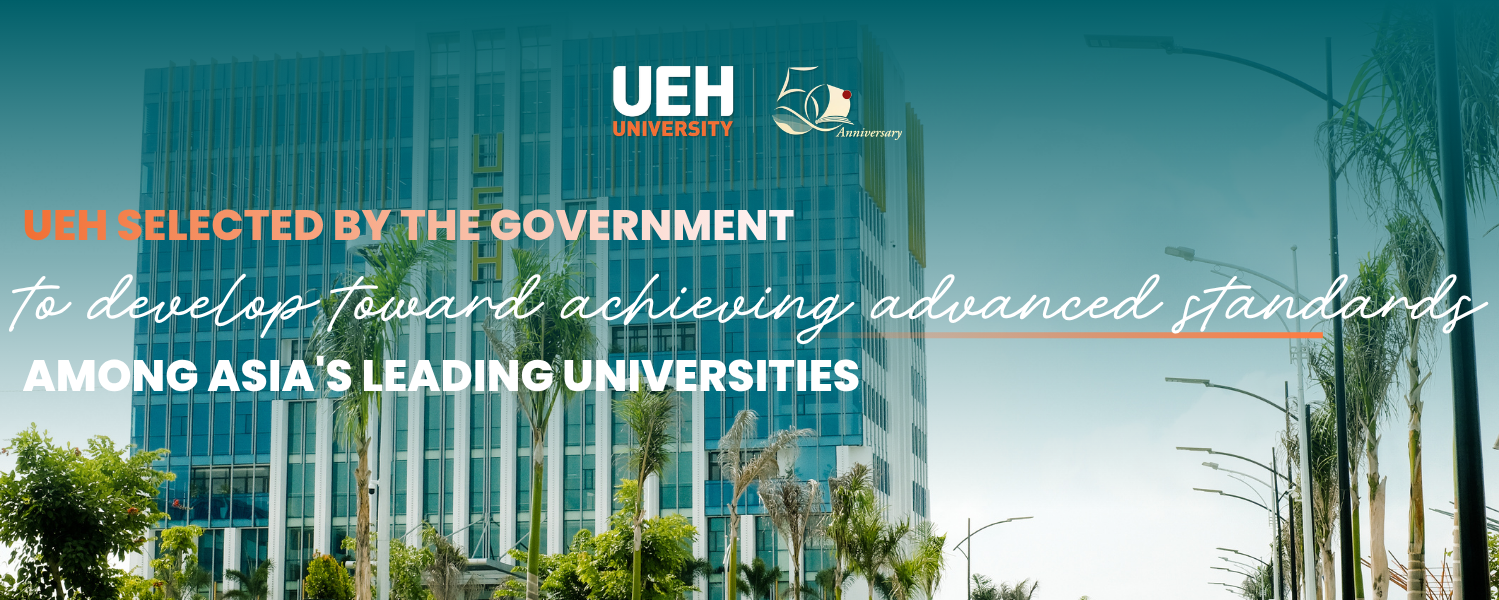
UEH selected by the Government to develop toward achieving advanced standards among Asia's leading universities
30 May, 2026

The Prime Minister has just approved the Project on developing a number of major higher education institutions in the Southeast region toward achieving advanced standards among Asia's leading universities, under Decision No. 966/QĐ-TTg. Accordingly, the University of Economics Ho Chi Minh City (UEH) is one of three higher education institutions selected for priority development, together with Vietnam National University Ho Chi Minh City, forming a core nucleus for high-quality human resource training, scientific research, technology development, and innovation for Ho Chi Minh City, the Southeast region, and the country as a whole.
This is not only a recognition of UEH's capacity, standing, and contributions over nearly half a century of development, but also opens a new phase for the University to engage more deeply in the national strategy for human resource development, science and technology, innovation, and national competitiveness.
This decision is an important step toward developing the Southeast region into a dynamic, modern area with high competitive capacity in Asia; while affirming the role of higher education in driving scientific and technological development, innovation, digital transformation, green transition, and international integration.
UEH becomes one of the Southeast region’s knowledge hubs
According to the Project, the overall objective is to develop UEH, together with the University of Medicine and Pharmacy at Ho Chi Minh City, Vietnamese-German University, and Vietnam National University Ho Chi Minh City, into leading centers of education, scientific research, innovation, and technology transfer with advanced standards in Asia, serving as key growth drivers for Ho Chi Minh City and the Southeast Region.
In particular, UEH is entrusted with continuing to leverage its strengths in economics, business, management, finance, public policy, and emerging interdisciplinary fields. The University will contribute to developing high-quality human resources, producing impactful research, and generating innovative solutions that support local governments, businesses, and communities.
Objectives to 2030: Maintaining a position among Asia's leading universities and building a sustainable foundation for the next phase
To achieve the Government’s objectives, UEH aims to accelerate its development comprehensively in education quality, scientific research, faculty excellence, internationalization, and innovation capacity during the 2026-2030 period.
Currently ranked among the Top 184 universities in Asia (THE Asia University Rankings 2026), UEH strives to maintain and strengthen its position while expanding its academic presence and contributions across Southeast Asia.
Accordingly, regarding the education pillar, UEH has set the following key objectives
-
Train approximately 9,000 high-quality undergraduate and postgraduate graduates annually, including talent for the nation’s strategic sectors.
-
Improving faculty quality with at least 70% of full-time lecturers holding doctoral degrees; approximately 20% being professors and associate professors; 12% being international faculty.
-
Attract approximately 30 leading global scholars to participate in teaching and research activities.
-
Develop approximately 50 talented young lecturers and researchers capable of leading key academic disciplines.
Regarding the scientific research pillar:
-
Target an average of at least 4.1 scientific publications per lecturer.
-
Reach an average of 12.2 citations per publication; obtain at least one patent annually.
-
Develop 20 strong research groups comprising domestic and international scholars and industry experts.
For the internationalization strategy, UEH focuses on:
-
Increase the proportion of international students to at least 3.1%; ensure all academic programs can be delivered in English.
-
Establish partnerships with approximately 50 universities ranked among Asia’s Top 250 institutions.
-
Ensure that at least 70% of programs achieve regional or international accreditation standards, and at least 90% are benchmarked against programs offered by universities ranked among Asia’s Top 250.
Objectives to 2035: Positioning UEH among the Top 100 universities in Asia - A knowledge hub driving HCMC and the Southeast region to become a leading center of Economics, Finance, and Innovation in the region by 2050
By 2035, UEH is oriented toward becoming a multidisciplinary, multi-field university ranked among the top 100 higher education institutions in Asia in economics, business, and management.
According to the Project, during this period, UEH will continue to fulfill its role as a key public university in the Southeast region and the country; possess modern technical infrastructure and facilities that meet regional standards; and actively contribute to the development of Ho Chi Minh City and the Southeast region.
By 2050, UEH, together with the three aforementioned universities, will serve as a Knowledge Hub driving Ho Chi Minh City and the Southeast region to become one of Vietnam's and Southeast Asia's leading centers of economics, finance, education, healthcare, and innovation.
UEH's 50-Year milestone: The beginning of a new phase of development with synchronized strategic tasks and solutions
To realize the above objectives, UEH will synchronously implement the following key solution groups:
- Building a smart university with international connectivity: Upgrading infrastructure and facilities in line with the smart university model; expanding development spaces in Vinh Long and Khanh Hoa; accelerating AI applications; developing digital learning materials and data systems connected to the national database.
- Developing a high-quality academic faculty: Building a faculty of lecturers and scientists meeting regional and international standards; strengthening doctoral training, attracting reputable experts from home and abroad, and contributing academic human resources to Vietnam's higher education system.
- Reforming training in line with the digital economy and sustainable development: Updating curricula to meet the standards of Asia's top universities; developing multidisciplinary and interdisciplinary programs integrating digital transformation, green transition, innovation, and sustainable development; advancing internationalization and global training partnerships.
- Promoting research, innovation, and knowledge transfer: Developing priority research areas, strong research groups, and centers of research excellence; improving the quality of international publications and completing an innovation ecosystem aligned with practical needs.
- Strengthening regional connectivity and partnering with local communities and enterprises: Expanding cooperation in training, research, policy advisory, and knowledge transfer, contributing to high-quality human resource development and socio-economic advancement in the Southeast region.
These solution groups are currently being implemented in detail by UEH through 10 key strategic projects for 2025-2030:
-
Elevating the quality of UEH's faculty and staff;
-
Building an international academic ecosystem at UEH;
-
Enhancing capacity in scientific research, international publications, science and technology transfer, and product commercialization;
-
Training high-quality human resources with international orientation, practical relevance, multidisciplinary integration, digital transformation, and sustainability;
-
Developing a startup and innovation ecosystem at UEH, becoming a core startup and innovation hub connecting the Vietnamese and Asian startup community;
-
Effectively developing the UEH alumni network through meaningful and sustainable engagement programs;
-
Implementing the City University model with the university as a central hub connecting government, businesses, and communities on the basis of co-creation and sustainable action;
-
Modernizing technical infrastructure and facilities, ensuring effective governance and financial sustainability;
-
Upgrading UEH's comprehensive digital transformation in line with European frameworks;
-
Implementing a university model with a happy and thriving environment.
Commenting on the Government's decision, Assoc. Prof. Bui Quang Hung - President of the University of Economics Ho Chi Minh City, stated:
"Being selected by the Government as one of the key higher education institutions of the Southeast region is a great honor, and equally a great responsibility for the entire UEH community. This recognition reflects the efforts in innovation, internationalization, and sustainable development that UEH has steadfastly pursued over the past 50 years, while also providing important motivation for the university to contribute ever more broadly to the development of Ho Chi Minh City, the Southeast region, and the country as a whole.
Following the transformation into a Multidisciplinary University and Sustainable Action in 2021, UEH is continuing its strategic shift toward the regional innovation hub model - 'UEH Univer-City Innovation Hub' - with the 10 aforementioned strategic projects, oriented toward connecting the university with the city, businesses, and the community to co-create value for the locality, the region, the nation, and the world. This serves as the foundational basis for UEH to realize the goals entrusted by the Government, progressively affirming its role as a key university, a knowledge and innovation hub of the Southeast region and Vietnam in the new phase of development."
The year 2026 marks the 50th anniversary of UEH's establishment and development (1976-2026). From a specialized economics university founded when the country was beginning its post-reunification reconstruction, UEH has steadily expanded its scale, enhanced educational quality, developed scientific research, promoted internationalization, and transformed into a multidisciplinary university dedicated to innovation and sustainable development.
Over nearly half a century, UEH has not only accompanied the development of Ho Chi Minh City and the country in human resource training, scientific research, policy advisory, and knowledge transfer, but has also progressively established the standing of a Vietnamese university on the regional and global educational map.
Pillar: Education, Research
News, Photos: Department of Communications and Partnerships