
Women4Mangrove Project: Enhancing Community-Based Conservation and Agro-Educational Tourism Linked to Reforestation in the Mekong Delta
19 Dec, 2025
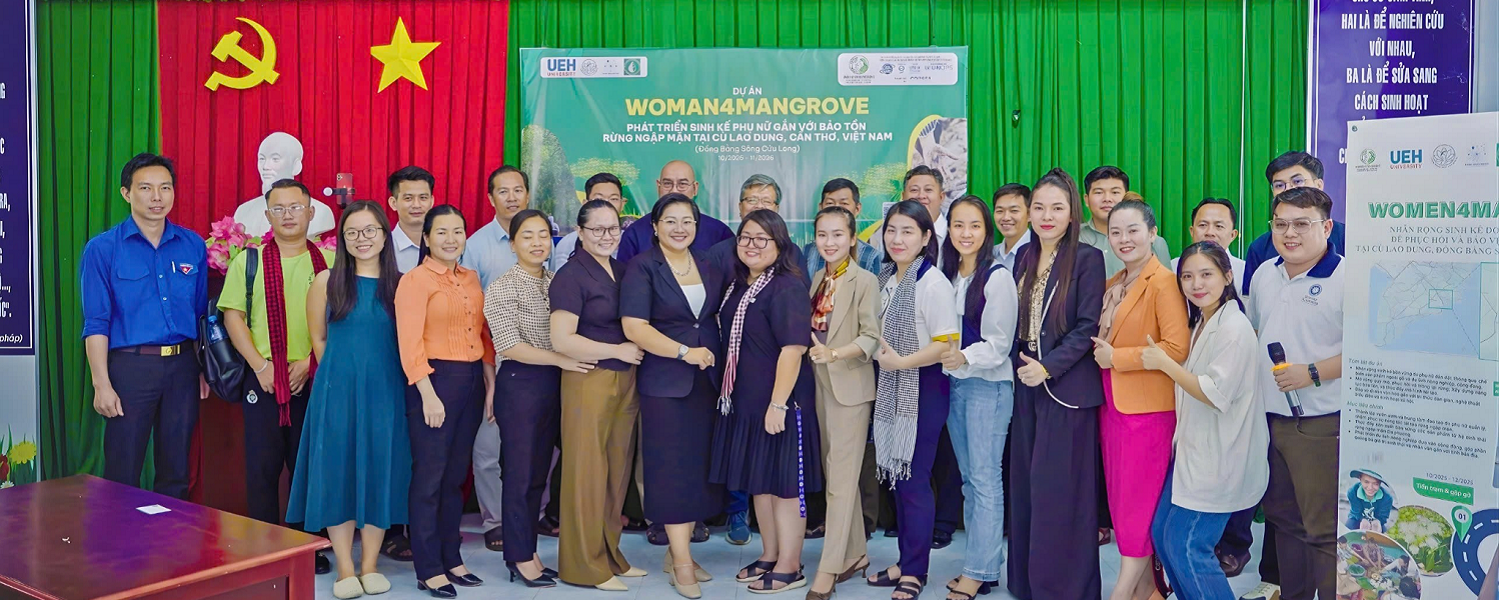
On December 10, 2025, the Women4Mangrove (W4M) Project successfully held a stakeholder meeting to underscore its mission of empowering women, protecting mangrove ecosystems, and developing a sustainable agro-educational tourism model in the Mekong Delta. The event brought together representatives from local authorities, the community, environmental experts, and development partners to exchange ideas, discuss progress and align on the project's next milestones.
Empowering Women and Protecting Mangroves
Women4Mangrove aims to strengthen the role of women in mangrove conservation while creating sustainable livelihood opportunities through an agro-educational tourism model linked with afforestation. The project seeks to build a harmonious development model where community well-being, environmental protection, and economic growth are advanced in parallel.
.png)
Local women representatives participating in the meeting and discussing with the Women4Mangrove project team the direction for implementing mangrove conservation and sustainable livelihood activities
Community Consultation and Survey Results
At the event, the project team shared the results of community surveys conducted in the target communes. The findings revealed strong local interest in W4M's activities and clearly reflected the community's expectations for skills training, economic opportunities, and environmental education. This information serves as a crucial foundation for designing and implementing the project's subsequent activities.
.png)
A community survey was used by the project team to capture the needs, expectations, and readiness of local residents to participate
Field Research and Collaboration with Local Authorities
Prior to the official launch, the Women4Mangrove team conducted several field surveys in Cu Lao Dung and An Thanh communes. Working sessions with local authorities helped to define the necessary principles and standards for building an agro-educational tourism model linked with mangrove conservation. Discussions focused on requirements for tourist conduct, environmental protection criteria, and the responsibilities of local businesses in sustainable tourism development.
Learning from Regional and International Models
The project's initial results are demonstrated through expanded networking and learning from international experiences. Specifically:
- In Bangkok, Thailand (November 2025): Women4Mangrove was introduced to regional environmental and social impact networks.
- In Amsterdam, the Netherlands (December 2025): The project team studied the Community Wealth Building model, which provided valuable insights into how local communities can benefit more equitably from tourism and conservation activities.
These experiences are considered strategic milestones that will significantly contribute to refining the project's design and guiding its future expansion.
.png)
Delegates, partners, and the Women4Mangrove project team took a commemorative photo at an international professional exchange forum
Panel Discussion: Reinforcing a Shared Vision
The event's panel discussion provided a forum for representatives from local government, the community, experts, and partners to exchange views on needs, expectations, and cooperation opportunities. The contributions focused on building a community-led model for mangrove conservation and sustainable agro-tourism. The insightful feedback from all stakeholders has helped the project align its implementation direction more closely with local realities.
.png)
Delegates contributing their opinions during the panel discussion
With the active support of local authorities and guidance from domestic and international experts, the Women4Mangrove project will continue to implement activities aimed at fulfilling its mission of empowering women and protecting the mangrove ecosystems of the Mekong Delta.
.png)
Delegates took a commemorative photo
|
Women4Mangrove – Empowering Women for Nature-based Coastal Solutions is a project managed by the University of Economics Ho Chi Minh City (UEH) and implemented in the Mekong Delta, with funding from the United Nations through UNOPS/SEA Grants. The project aims to restore mangrove ecosystems while developing sustainable livelihoods for local women through nature-based solutions. These include mangrove planting and management, the development of community-based agro-educational tourism, and enhancing the capacity and leadership role of women in conservation and sustainable development. For more information, please visit:
|
Pillars: Research, Community Connection
Project: UEH Connecting
News, photos: Project Management Board, Department of Communications and Partnerships
![[UEH 50] Launching Ceremony UEH Technology Convergence Hub and UEH FLEX Pilot Project: A Convergence Point for Technology, Knowledge Connection, and Innovation for Sustainable Development](/images/upload/thumbnail/ueh-thumbnail-639285406692900729.png)
![[UEH 50] JABES Launches Special Issue Celebrating the 50th Anniversary of UEH: 12 Research Papers Accompanying Vietnam's Development Issues](/images/upload/thumbnail/ueh-thumbnail-639283721313299577.png)
![[UEH Through the Lenses of Time #01] UEH 50 Years: From the Classroom Window to the Aspiration to Contribute](/images/upload/thumbnail/ueh-thumbnail-639282664984784994.png)
![[UEH Through the Lenses of Time #02] School of Mathematics - Statistics: Generations of Deans and the Journey of Continuation](/images/upload/thumbnail/ueh-thumbnail-639282663344912443.png)
![[UEH Through the Lenses of Time #03] Half a Century, A Journey & Hundreds of Thousands of Hearts](/images/upload/thumbnail/ueh-thumbnail-639282661905215411.png)