
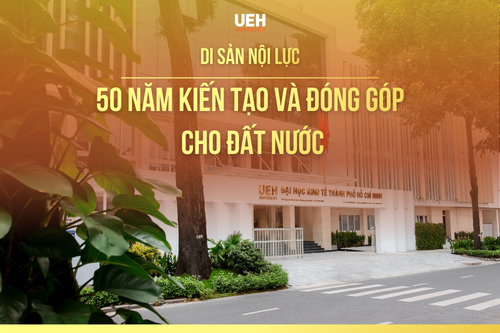
A Legacy of Inner Strength: 50 Years of Building and Contributing to the Nation
26 Feb, 2026
The Spring of 1975 ushered in an era of independence and reunification for the Vietnamese nation. Within this sacred historical current, in 1976, the University of Economics Ho Chi Minh City (UEH) was officially established – carrying with it the aspiration of "nation-building through knowledge," accompanying the cause of national reconstruction and development. After half a century of steadfast building and service through inner strength, UEH today has risen to become a multidisciplinary, sustainable, nationally key university with international academic prestige, contributing ever more profoundly to Vietnam's prosperous and sustainable development.
Origins from the Mission of the Era
Born in the early days following national reunification, the University of Economics Ho Chi Minh City (UEH) was officially established on October 27, 1976, becoming the first university in the economics and management sector in Southern Vietnam after liberation. In the context of a nation emerging from war, UEH bore an urgent mission: training a contingent of cadres in economics, finance, and management to serve the cause of reconstruction and development.
The period 1975–1976 marked the first challenging steps. Building upon the takeover of Saigon Law University and the merger of several pre-1975 economics training institutions, UEH quickly stabilized operations, assembled its faculty, renovated facilities, and organized admissions for its first full-time undergraduate cohort with 516 students. This was the initial foundation for a systematic, long-term training journey closely aligned with the nation's needs.
From 1977 to 1985, UEH focused on building foundations for training, research, and consultancy to serve national reconstruction. Entering the Doi Moi (Renovation) period (1986–2000), the university accompanied the transition to a market economy, training high-quality human resources and contributing numerous scientific arguments for policy formulation.
The period 2000–2010 marked UEH's brand affirmation as a nationally key public university, gradually integrating internationally through curriculum innovation, enhanced research, and academic cooperation. From 2011 to 2020, UEH vigorously implemented autonomy and internationalization, affirming its pioneering position in economics–management education, research, and consultancy in Vietnam.
From 2021 to the present, facing the demands of the technological era and sustainable development, UEH has transformed according to the Multidisciplinary and Sustainable University model. In 2023, UEH officially became one of the first higher education institutions in Vietnam to operate under the multidisciplinary, multi-field university model.
Over half a century of formation and development, UEH has risen through inner strength, resolve, and the aspiration to serve. From a university born amid hardship, UEH today is a multidisciplinary and sustainable university, continuing the mission of "nation-building through knowledge" in the country's development journey.

In 1975, UEH quickly took over the facilities of the Law University and commenced operations
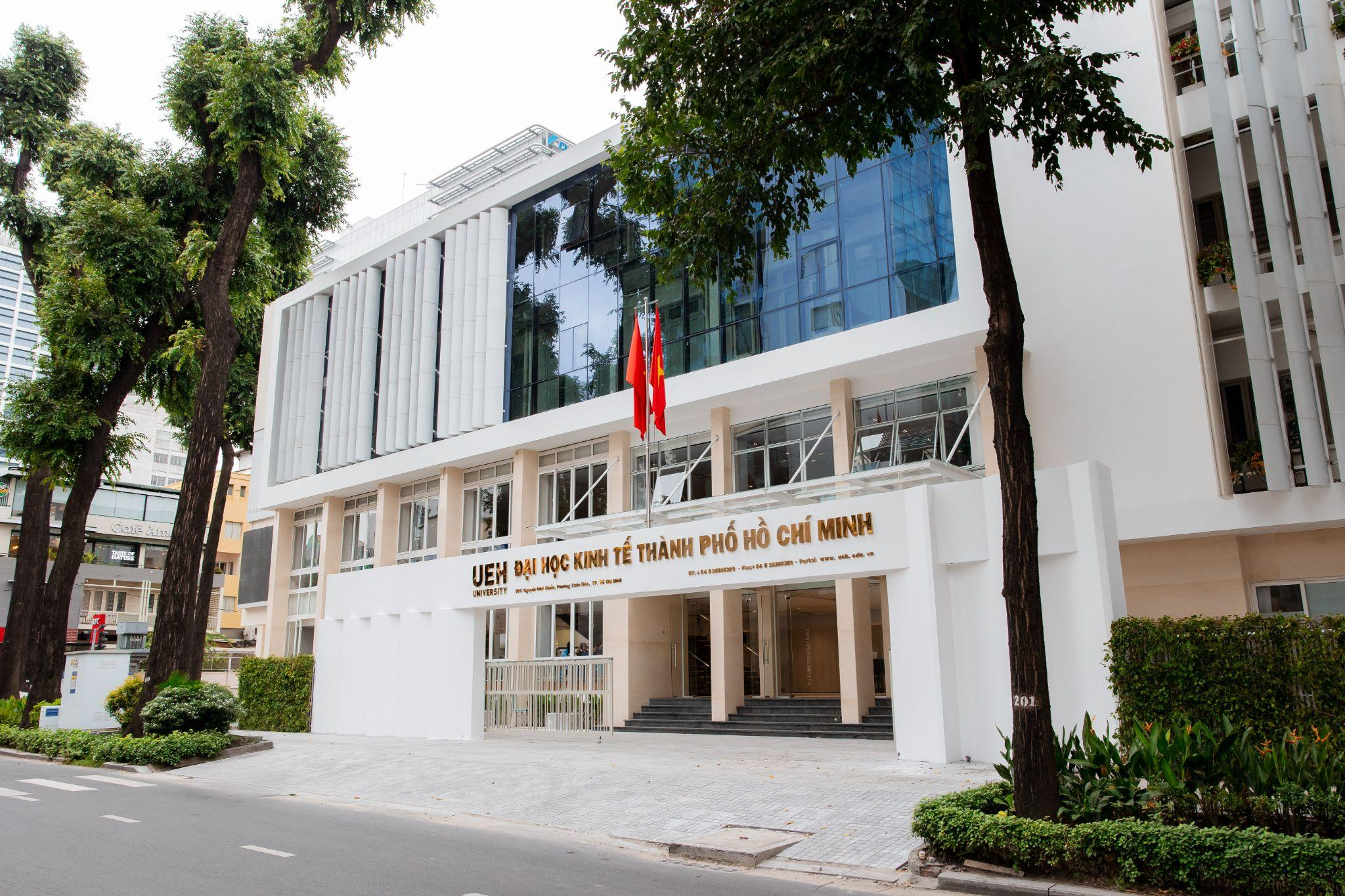
After 50 years of formation and development, UEH has become a nationally key university, contributing high-quality human resources to the entire nation
Milestones of 50 Years of Building and Contributing to the Nation
*Training: Cultivating Generations of Nation-Builders and Global Citizens
Over the past half-century, UEH has consistently fulfilled its mission of training high-quality human resources in economics and management, contributing directly to the nation's construction, development, and integration. Each year, UEH trains more than 30,000 learners across all levels and programs; over 280,000 UEH alumni currently hold key positions in state management apparatus, enterprises, international organizations, and the startup ecosystem.
Since 1975, UEH has trained more than 250,000 bachelor's degree holders and over 30,000 master's and doctoral graduates in fields including economics, management, finance, law, technology, and design – becoming one of the largest and most prestigious human resource training centers in the country. The system of 80 multidisciplinary, multi-field training programs is designed to approach the standards of world-leading universities and is continuously accredited and recognized according to prestigious international standards such as FIBAA (Europe) and AUN-QA.
Beyond classroom training, UEH also disseminates knowledge through an extensive cooperation network with international partners and major domestic enterprises and corporations. Thousands of short-term training programs and executive development courses for managers and leaders at all levels have been implemented across nearly 30 provinces and cities, contributing to enhanced operational and management capacity for both the public and private sectors.
*Research: Disseminating Knowledge for the Community
Alongside training, scientific research has been a pillar creating UEH's academic imprint and enduring policy contributions throughout the past 50 years. From research serving post-war economic reconstruction to scientific arguments for the Doi Moi (Renovation) cause, integration, and sustainable development, UEH has always been present as a knowledge center closely connected to the nation's development reality.
To date, UEH has published more than 3,500 scientific articles in prestigious international journals indexed in Scopus/ISI/ABDC systems and implemented hundreds of research projects at various levels. Many research results have been transferred and applied in practice, serving policy formulation and the development of enterprises and sustainable cities.
During the nation's critical moments – from the period of international economic integration, the COVID-19 pandemic, to the process of growth model transformation – UEH has always promptly organized scientific forums, economic reports, and national conferences, providing scientific arguments for governance and development recovery. The series of research and policy critique activities in recent years continues to affirm UEH's pioneering role in the national knowledge ecosystem.
*Governance: Democracy – Transparency – Fairness
UEH identifies modern university governance as a prerequisite for sustainable development. On the foundation of university autonomy, UEH steadfastly implements the principle of "Democracy – Transparency – Fairness," ensuring all members participate in the decision-making process and enjoy a fair working and learning environment.
UEH's governance system is standardized according to international practices, linking strategic objectives with OKRs of each unit while integrating sustainability criteria from prestigious rankings such as QS Sustainability, THE Impact, and UI GreenMetric. This governance foundation helps UEH maintain stability, enhance operational efficiency, and remain ready to adapt to the rapid changes in global higher education.
*Operations: A Sustainable University from Vision to Action
Throughout its development, UEH has gradually realized the "University as a Sustainable Micro-City" model – a university as a sustainable miniature city. UEH's operational strategy synchronously integrates environmental, technological, social, and modern management elements.
Through the UEH Green Campus project, the university has reduced 6.4 tons of landfill waste by implementing waste sorting at source and responsible consumption. Concurrently, UEH accelerates digital transformation in management, training, and research, optimizing resources and enhancing the learner experience. The sustainable operations model not only helps UEH save costs but also contributes to forming a green, humane, and responsible university culture.
*Community: Accompanying the Sustainable Development of Localities
UEH has always identified its mission as extending beyond the classroom to the community, localities, and society. The university has been cooperating with 117 international partners from 32 countries while maintaining a network of more than 500 enterprises and corporations as strategic partners in training, research, and knowledge transfer.
In the field of public sector training and cadre development, UEH has implemented thousands of short-term training courses, along with bachelor's and master's programs in public management for nearly 30 provinces and cities from central to local levels. Through academic forums, particularly the International Forum on Sustainability (IFS), UEH connects stakeholders, promotes cooperation, and makes practical contributions to the implementation of the United Nations' 17 Sustainable Development Goals (SDGs).
A consistent development strategy across all five pillars has enabled UEH to progressively affirm its position as a multidisciplinary, sustainable university with international prestige, being ranked on the world's most prestigious academic rankings: Top 501–600 best universities globally (Times Higher Education 2026), Top 136 leading universities in Asia (Times Higher Education 2025), Top 650 sustainable universities globally (QS Sustainability 2026), and Top 301–400 universities with outstanding contributions to the United Nations' 17 Sustainable Development Goals (THE Impact Rankings).
A Legacy of Inner Strength – 50 Years of Steadfastly Building UEH
Half a century of UEH is measured not only by buildings, training programs, or rankings, but also by the legacy of inner strength passed down through generations.
It is the spirit of solidarity and camaraderie during the early years of scarcity; the dedication and academic ethics of generations of educators; the responsibility of serving the community and nation embedded in every training program and research project; and the aspiration for pioneering, building, and sustainable integration in every transformation of the university.
This very legacy of inner strength serves both as a foundation and a driving force, enabling UEH to steadfastly create value, serve society, and confidently stride forward on the path of internationalization and sustainable development in the future.
The year 2026 – marking the 50th anniversary of the establishment of the University of Economics Ho Chi Minh City – is the moment for UEHers to look back together at a historical film written with intellect, passion, and ceaseless dedication. At the same time, it is the moment to launch a new development phase – taking UEH forward with a greater aspiration: to become one of the leading multidisciplinary and sustainable universities in Asia, contributing ever more profoundly to the nation's prosperous development.

UEH – The origin of the journey of "nation-building through knowledge," steadfastly building for 50 years (1976–2026)
News, photos: Department of Communications and Partnerships
![[UEH 50] Launching Ceremony UEH Technology Convergence Hub and UEH FLEX Pilot Project: A Convergence Point for Technology, Knowledge Connection, and Innovation for Sustainable Development](/images/upload/thumbnail/ueh-thumbnail-639285406692900729.png)

![[UEH 50] JABES Launches Special Issue Celebrating the 50th Anniversary of UEH: 12 Research Papers Accompanying Vietnam's Development Issues](/images/upload/thumbnail/ueh-thumbnail-639283721313299577.png)
![[UEH Through the Lenses of Time #01] UEH 50 Years: From the Classroom Window to the Aspiration to Contribute](/images/upload/thumbnail/ueh-thumbnail-639282664984784994.png)
![[UEH Through the Lenses of Time #02] School of Mathematics - Statistics: Generations of Deans and the Journey of Continuation](/images/upload/thumbnail/ueh-thumbnail-639282663344912443.png)
![[UEH Through the Lenses of Time #03] Half a Century, A Journey & Hundreds of Thousands of Hearts](/images/upload/thumbnail/ueh-thumbnail-639282661905215411.png)