

QS by Subject 2026: 03 UEH Disciplines Achieve Global Rankings
25 Mar, 2026

Expanding from the Foundation of Social Sciences
At the field level, UEH continues to rank among the Top 501–550 globally in Social Sciences & Management.
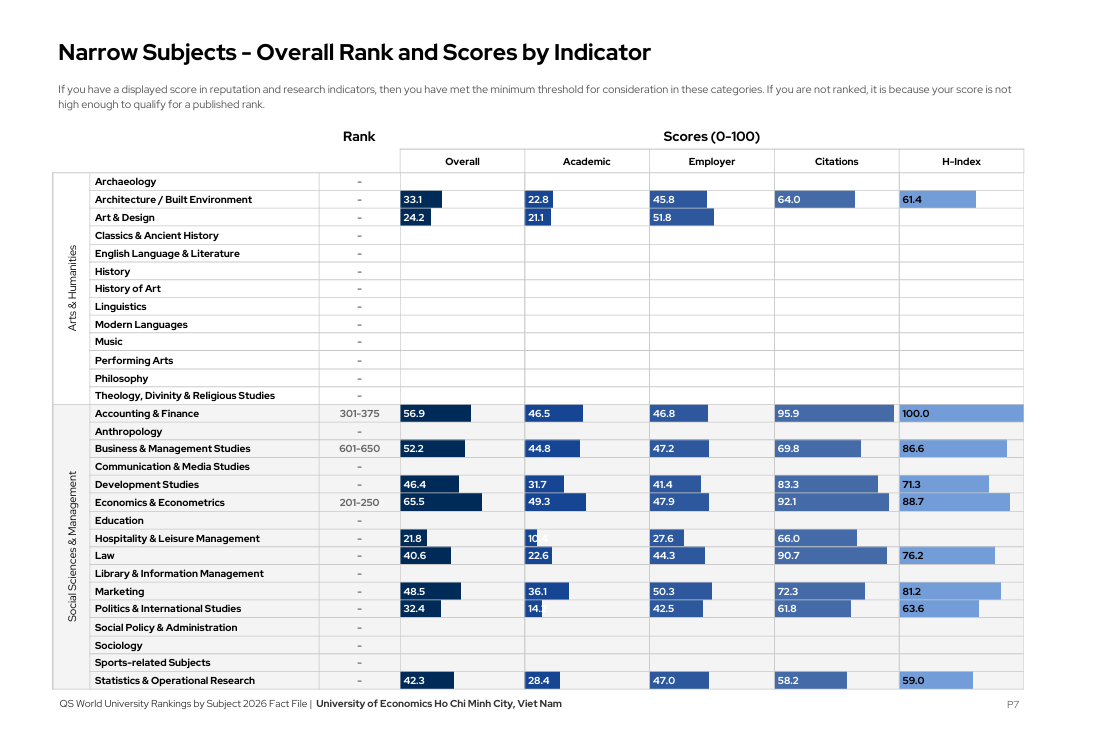
Notably, 03 UEH disciplines have been ranked in this year’s assessment. Economics made a breakthrough, climbing to the Top 201–250 globally, up about 50 places from last year, and moving closer to the world’s top 200 universities. At the same time, Accounting and Finance (Top 301–375) and Business (Top 601–650) were ranked for the first time.
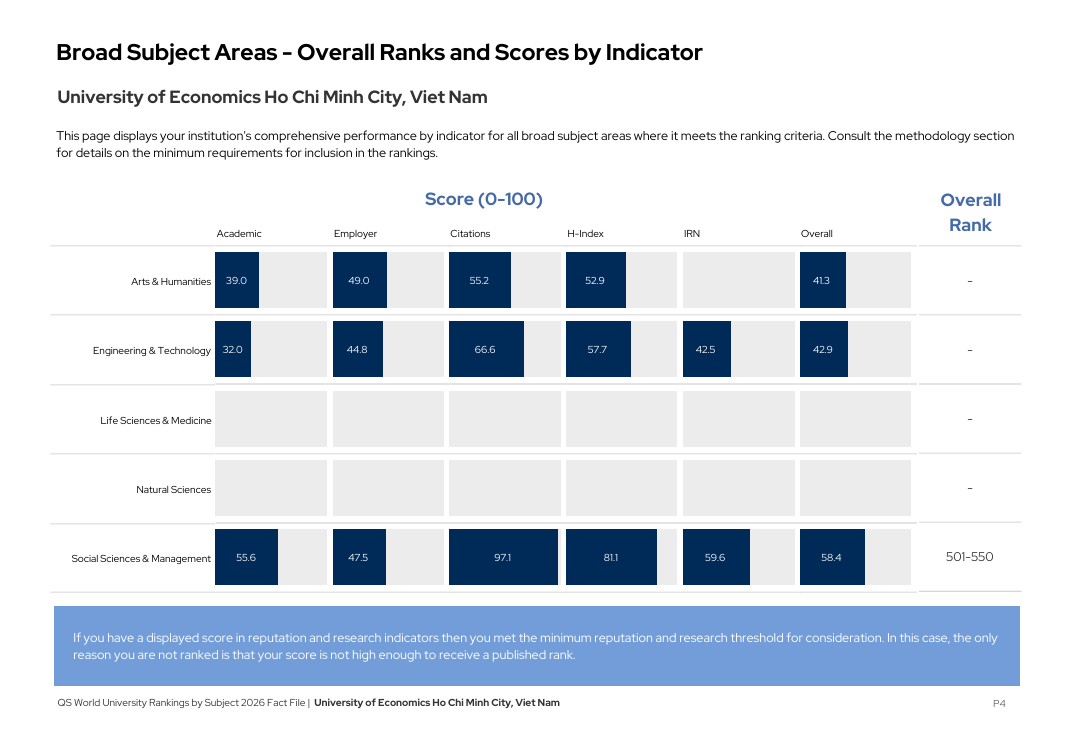
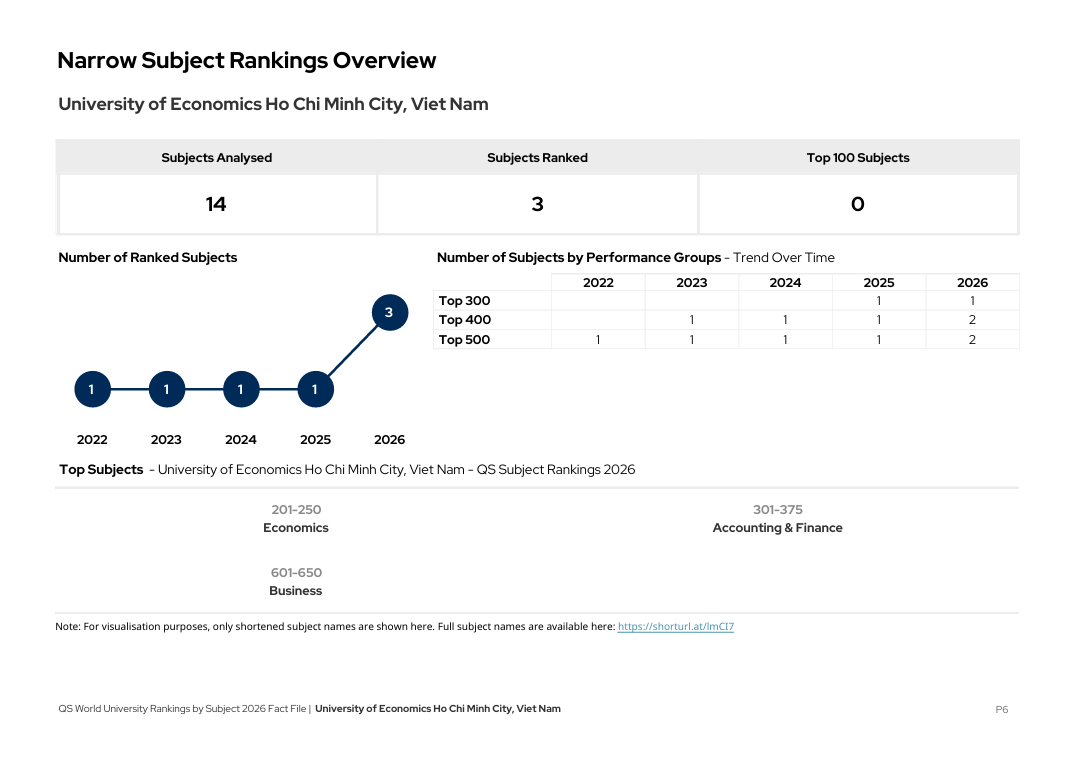
According to QS methodology, the rankings are based on five criteria: (1) Academic reputation; (2) Employer reputation; (3) Citations per paper; (4) H-index; and (5) International research network. These criteria comprehensively reflect the teaching and research capabilities, as well as the level of academic integration, of higher education institutions worldwide.
Thus, beyond improving its rankings, this growth also reflects a structural trend: UEH’s Social Sciences disciplines are moving closer to international ranking standards. The increase in publications, the expansion of research networks, and the accumulation of academic reputation are creating momentum for more disciplines to be recognized in upcoming rankings.
Growing Presence in New Fields Linked to Technology, Computing, Creative Engineering, and Applications
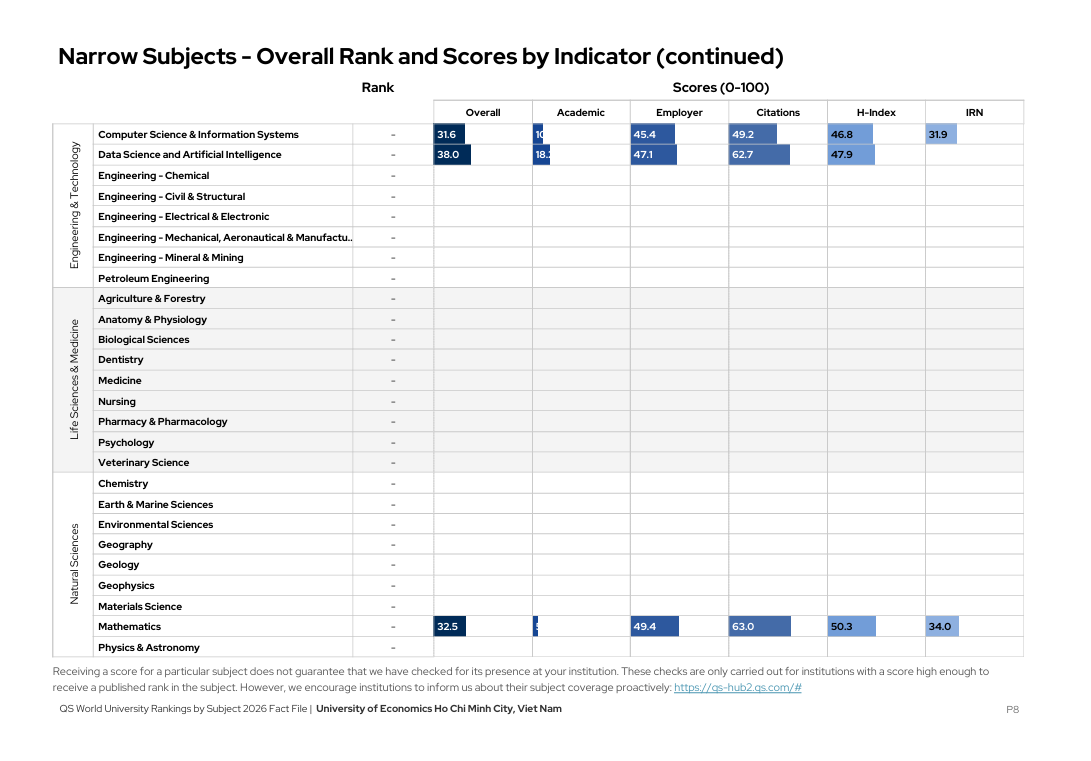
In parallel, new multidisciplinary fields associated with technology, such as Design, Architecture, Technology, Computer Science, Information Systems, Data Science, and Artificial Intelligence, are also gradually accumulating academic data and are expected to have the potential to enter this ranking in the near future.
Assoc. Prof. Bui Quang Hung - Interim President of UEH, declared: “The QS Subject 2026 results show that UEH’s direction is proving effective: from a university specializing in Economics and Management, it is transforming into a multidisciplinary model, connecting its traditional disciplines with technology, computing, creative engineering, and applied fields at UEH.”
Over the past five years of transformation, many innovative programs designed to integrate technology, business, and management have been launched, meeting the human resource needs of the digital economy and providing a research foundation for participation in international rankings in new fields. Typical examples include: Smart City, Computer Science, Information Technology, Robotics and Artificial Intelligence, Intelligent Control and Automation, Smart Urban Architecture and Design, Intelligent Manufacturing, Smart Operations and Mobility Management, ArtTech, MarTech, FinTech, LogTech, Biztech, Corporate Sustainability and Environmental Management, and Data Analysis.
|
GLOBAL RANKINGS OF UEH FIELDS AND DISCIPLINES
|
|
HOW UEH MANAGES UNIVERSITY RANKING ACTIVITIES To manage university rankings sustainably, UEH implements a governance process consisting of 7 steps: See information on how UEH manages university ranking activities: |
![[UEH 50] Launching Ceremony UEH Technology Convergence Hub and UEH FLEX Pilot Project: A Convergence Point for Technology, Knowledge Connection, and Innovation for Sustainable Development](/images/upload/thumbnail/ueh-thumbnail-639285406692900729.png)



![[UEH 50] JABES Launches Special Issue Celebrating the 50th Anniversary of UEH: 12 Research Papers Accompanying Vietnam's Development Issues](/images/upload/thumbnail/ueh-thumbnail-639283721313299577.png)

![[UEH Through the Lenses of Time #01] UEH 50 Years: From the Classroom Window to the Aspiration to Contribute](/images/upload/thumbnail/ueh-thumbnail-639282664984784994.png)
![[UEH Through the Lenses of Time #02] School of Mathematics - Statistics: Generations of Deans and the Journey of Continuation](/images/upload/thumbnail/ueh-thumbnail-639282663344912443.png)
![[UEH Through the Lenses of Time #03] Half a Century, A Journey & Hundreds of Thousands of Hearts](/images/upload/thumbnail/ueh-thumbnail-639282661905215411.png)